

President Gustavo Petro’s surprise 23% minimum wage increase for 2026 forced Colombian financial analysts to hastily revise their macroeconomic projections on New Year’s Eve, with expectations shifting dramatically for inflation, GDP, dollar exchange rates, and unemployment.
We should just write 500 words on why accurate forecasting this year will be impossible, add 200 words on the benefits of scenario-based planning and try to otherwise keep our head down. But we promise you courageous comments so here we go.
The Colombian gas producer published an update press release on its website. We also picked up an item on CNE from Superservicios.
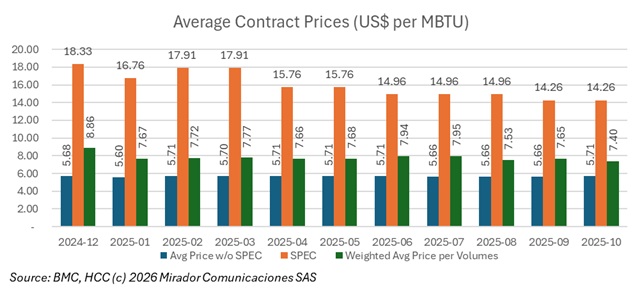
President Gustavo Petro requested that state-owned Ecopetrol substantially reduce internal natural gas prices as Colombia confronts a growing gas shortage forcing dependence on costlier imports. According to the country’s commodities exchange, internal gas production is projected to fall up to 20% below demand next year.
Colombia’s Works for Taxes (Obras por Impuestos) mechanism will begin 2026 without an approved quota, according to the Territorial Renewal Agency (ART), which confirmed that despite inquiries from companies, territorial entities, and community organizations, the maximum amount for 2026 remains undefined.
Colombia’s government seeks to convert a transitional 1% tax on petroleum, gas, and coal extraction into a permanent levy through an economic emergency decree, following Congress’s rejection of the tax reform legislation that originally contained this measure. Finance Minister Germán Ávila indicated that, after the financing law’s failure, the emergency mechanism would be utilized to recoup resources needed to complete the COP$546T budget.
Colombia’s National Planning Department (DNP) identified execution alerts in 3,275 royalty-funded projects valued at COP$19.7 trillion through the General Royalties System monitoring. The alerts emerged among 5,950 total projects reviewed, affecting potential completion and development of these initiatives.
Colombia’s Colombian Petroleum and Gas Association (ACP) president Frank Pearl acknowledged the Petro government presented significant challenges for the oil and gas sector, but emphasized some technical advances occurred despite policy headwinds.
Colombia’s government unveiled comprehensive measures addressing anticipated 2026 gas deficits through coordinated actions with sector agents, the Superintendence of Public Utilities (SSPD), and the Superintendence of Industry and Commerce (SIC).
We justify our three-week end-of-year vacation by the limited amount of news the industry produces over the period. This year was no exception, at least in the oil and gas sector as strictly defined. However, President Gustavo Petro continues his class warfare. NOTE: See end of article for a brief commentary on this weekend’s events.

2026, Hydrocarbons Colombia, All Rights Reserved.
