

Following a meeting with the Colombian Natural Gas Association (Naturgas), Minister of Environment Fabio Arjona endorsed natural gas as a fundamental fuel for Colombia’s energy transition, framing it as compatible with energy security, emissions reduction, and territorial protection.
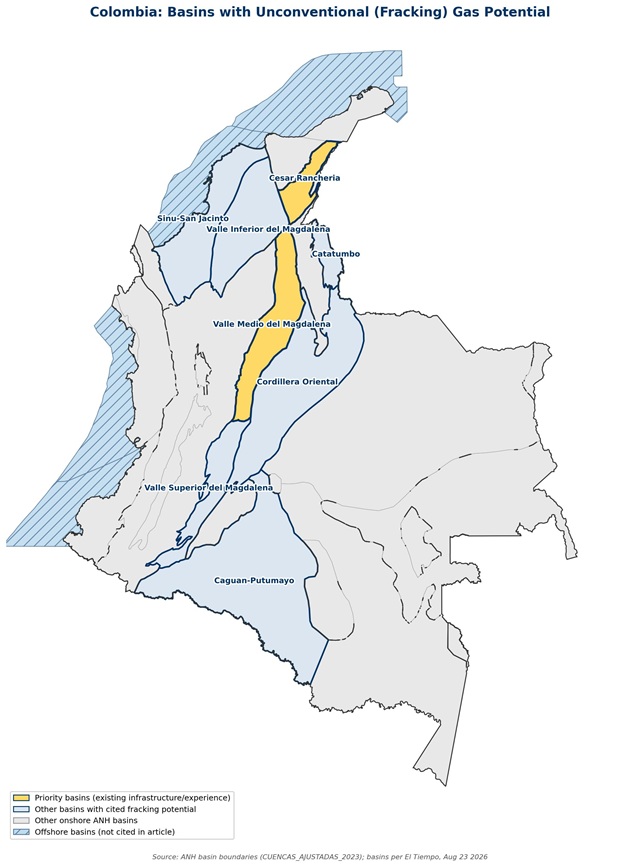
President Abelardo De la Espriella’s arrival has revived hopes of restoring Colombia’s natural gas self-sufficiency through unconventional reservoir development, with industry experts pointing to substantial potential across eight basins beyond the long-discussed Middle Magdalena Valley, following more than 15 years of regulatory and environmental debate.
Electricity market controller XM’s interim general manager Juan Carlos Morales was direct about what backing up Colombia’s hydro-dependent grid through El Niño will require: ‘we’re going to need coal and gas, as well as liquid fuels… the entire generation chain of the system will be called upon.’
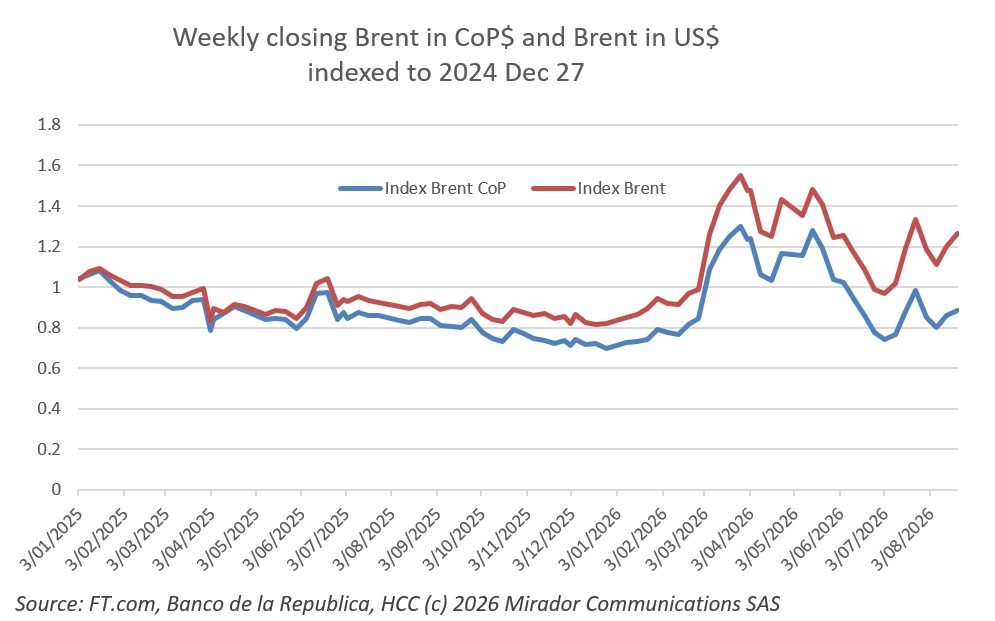
The Colombian peso closed Wednesday, August 19 at CoP$3,039 to the dollar, its strongest level since 2018, with the year-to-date decline in the exchange rate now exceeding 17.5%, roughly CoP$658 less per dollar than where the year began (~CoP$3,757).
Colombia’s mining-energy sector is projected to post a 0.3% GDP contraction in the second quarter of 2026, extending a decline that traces back to the first quarter of 2024.
We easily accept that 18th Century technology was radically different from today, but we can be shocked to find that human and political issues haven’t changed.
Colombia’s Ministry of Environment and Sustainable Development swore in its new leadership team on August 13, including Sergio Arturo Piñeros Botero as director of the Agencia Nacional de Licencias Ambientales (ANLA) — the agency responsible for environmental licensing of major hydrocarbons projects, from offshore exploration wells to pipeline infrastructure like SPEC’s recent capacity expansion.
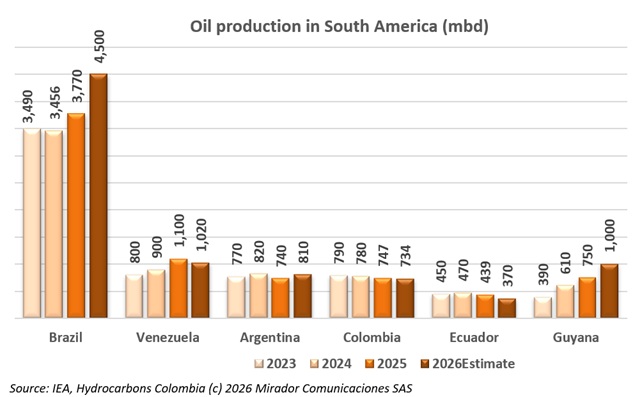
Colombia has lost relevance on Latin America’s oil production map, according to new International Energy Agency (IEA) projections, while Brazil, Argentina, and even Guyana — a country with essentially no oil industry a decade ago — accelerate output.
In an El Heraldo opinion column, Aquiles Mercado argues that global energy security has moved to the center of IMF and World Bank discussions, with the Iran conflict standing as the top geopolitical risk to oil markets — a blocked Strait of Hormuz or disrupted production, he writes, could create a shortage larger than the pandemic’s and reignite inflationary pressure.
President Abelardo De la Espriella used his first address as president, delivered from Batallón Pichincha in Cali, to declare that recovering Ecopetrol will be an absolute priority of his administration, alongside reactivating hydrocarbons exploration and authorizing fracking under environmental standards.

2026, Hydrocarbons Colombia, All Rights Reserved.
