

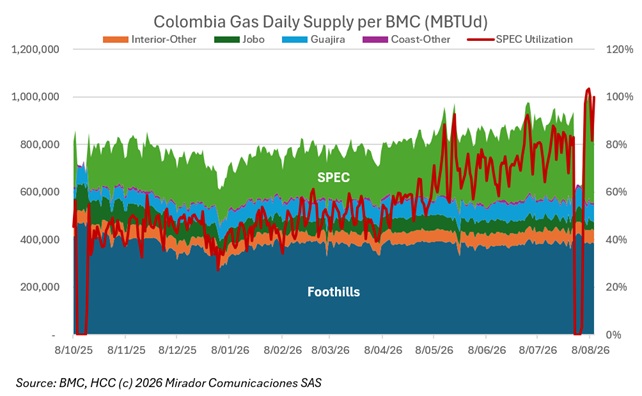
Colombia’s natural gas production fell 12.9% year-on-year in May 2026, to 1,129 million cubic feet per day (mmcfd) from 1,296 mmcfd in May 2025, with the decline attributed to Casanare, Sucre, Boyacá, and Córdoba.
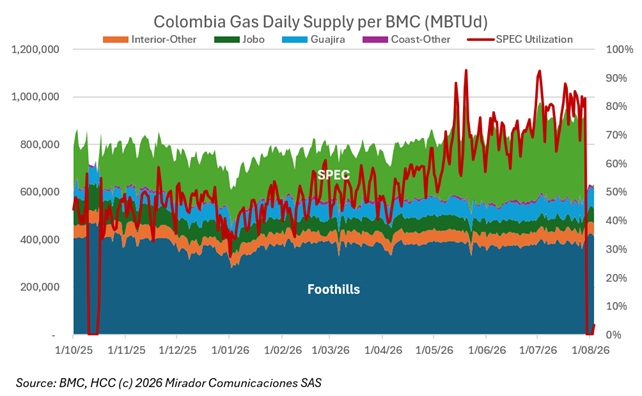
By now you must know that we made it through the SPEC maintenance window without regulated customers noticing anything and no power blackouts. If we hadn’t, you certainly would have heard about it.
The Ministry of Mines and Energy reported that scheduled maintenance at the SPEC regasification terminal in Cartagena reached 79% completion as of the morning of August 2, with the ministry projecting 86% progress by midnight and full completion by midday August 3, followed by a cooling phase ahead of restart.
Minister Edwin Palma used the opening of the Foro de Gas 2026 in Bogotá on July 30 – the same day SPEC’s scheduled five-day maintenance began – to issue a formal government guarantee of continuous essential gas and electricity supply through August 3.
Colombia’s most consequential gas supply event of 2026 begins Thursday. SPEC confirmed its maintenance window runs July 30th to August 3rd, with the coordination process for the five-day closure having involved thermal generators, non-thermal terminal users, the FSRU operator, and energy sector authorities.
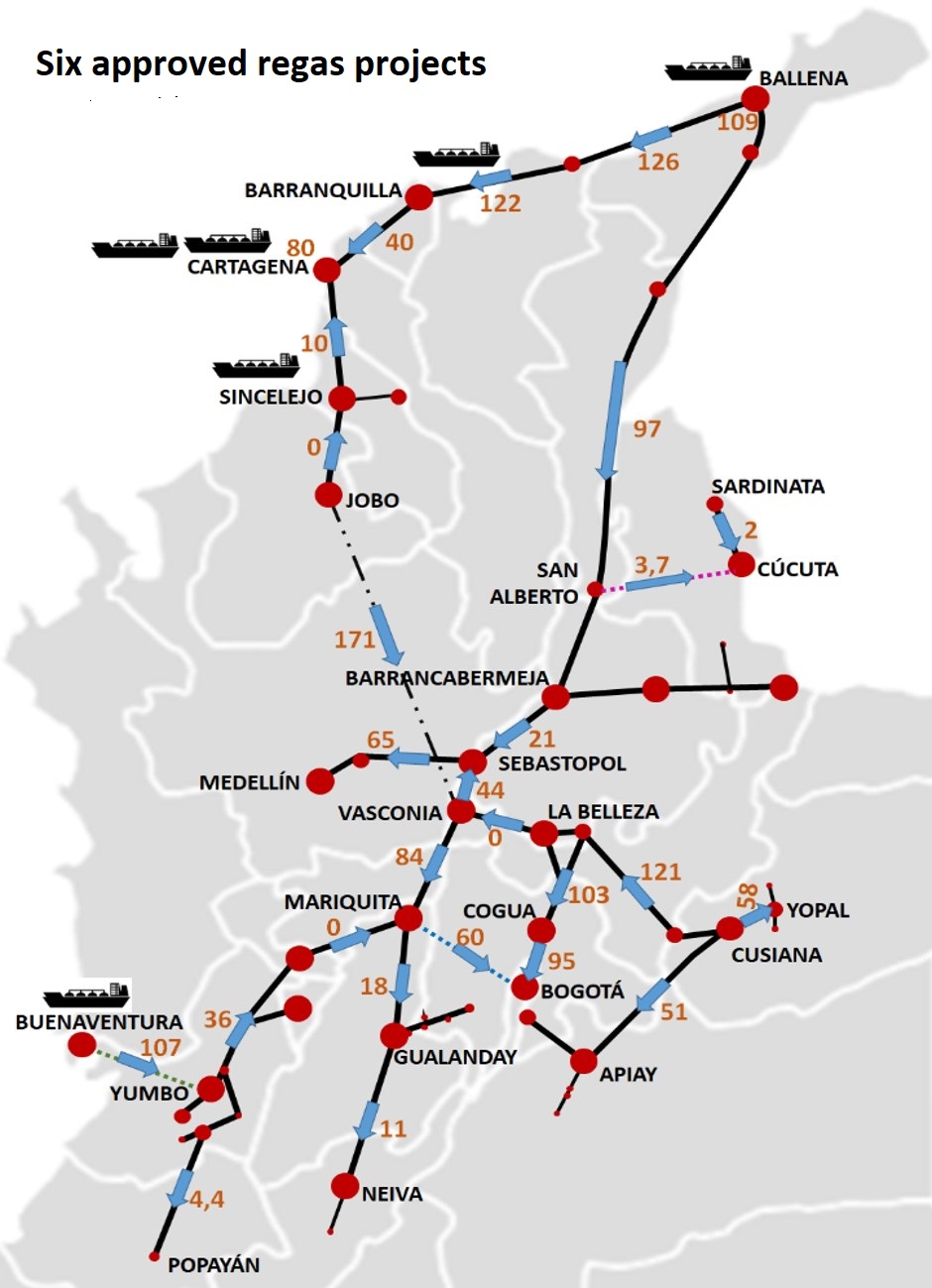
The Regasificadora del Pacífico (RDP) project in Guadalajara de Buga, Valle del Cauca has surpassed 80% construction completion and remains on track to enter commercial operations before year-end, then-Mines and Energy Minister Edwin Palma confirmed during a July 16 site visit.
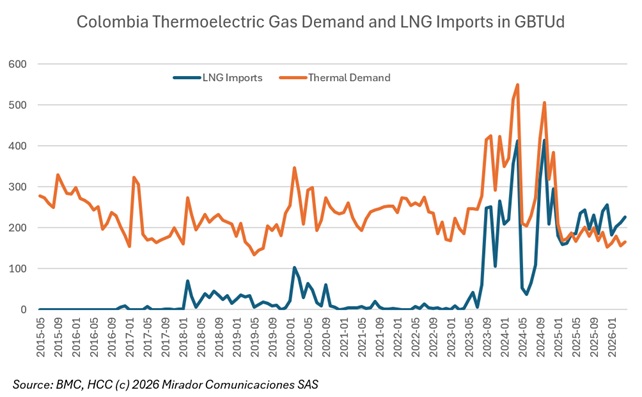
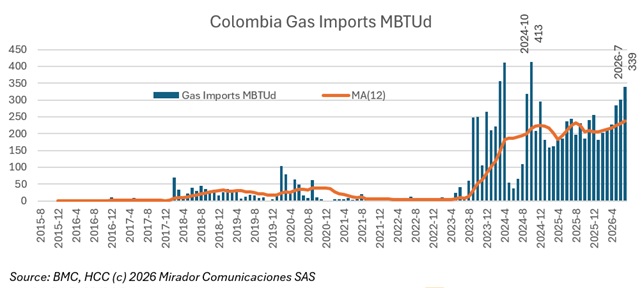
Colombia’s natural gas supply picture has deteriorated sharply since the start of 2026.
Colombia’s third LNG regasification project reached a visible construction milestone in late June when the Sociedad Portuaria Regional de Buenaventura received 30 heavy components — individual pieces weighing between 37 and 76 tonnes — destined for the regasification facility being built in Buga, Valle del Cauca.
Colombia’s energy regulator CREG released an infographic guide explaining how it will manage the continuity of liquefied petroleum gas (LPG) public distribution service under its PERP/PC regulatory project framework, a process designed to ensure that LPG infrastructure remains operational when existing operators cannot or will not continue executing a project.
Colombia’s energy regulator CREG took a concrete step toward regulating hydrogen injection into the national gas transport network on June 24, hosting a sector workshop and publishing two technical studies on the economics and engineering of hydrogen-natural gas blending (H2+CH4) in the Sistema Nacional de Transporte (SNT).

2026, Hydrocarbons Colombia, All Rights Reserved.
