

Colombia is preparing a new import point for gas and other energy products in Ciénaga and Santa Marta, Magdalena.
Vice President José Manuel Restrepo said Colombia’s bilateral agenda with the United States includes discussion of energy interconnection with Venezuela, specifically referencing the Antonio Ricaurte pipeline in northern Colombia as a potential route for importing gas from the country holding the world’s largest reserves.
Environment Minister Fabio Arjona detailed his ministry’s measures to shore up energy supply against El Niño during a September 9 congressional debate on the energy sector, the same session where MinEnergia Arboleda warned electricity tariffs must rise. Arjona said the ministry is working across several fronts, including expanding gas and water storage capacity for hydro dams.
Amazónica LNG formalized its contract with China’s Jereh Group, through subsidiary Jereh Oil & Gas Colombia, to advance construction of its regasification project in Palermo, Sitionuevo, Magdalena, an estimated US$180 million private investment.

Enercer S.A. E.S.P. announced a natural gas service suspension Tuesday night across 11 municipalities in eastern Boyacá — Garagoa, Tenza, La Capilla, Sutatenza, Guateque, Miraflores, Zetaquira, Berbeo, Páez, San Eduardo, and Campohermoso.
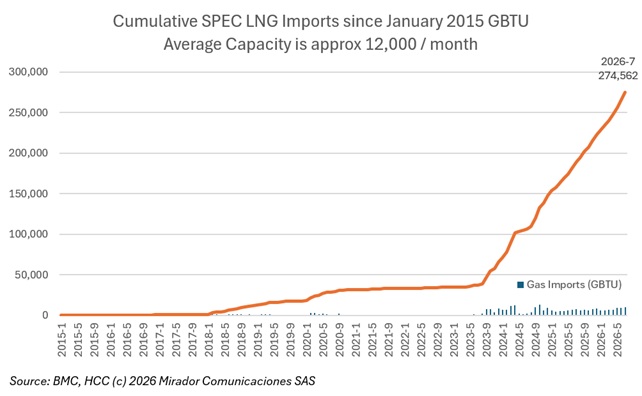
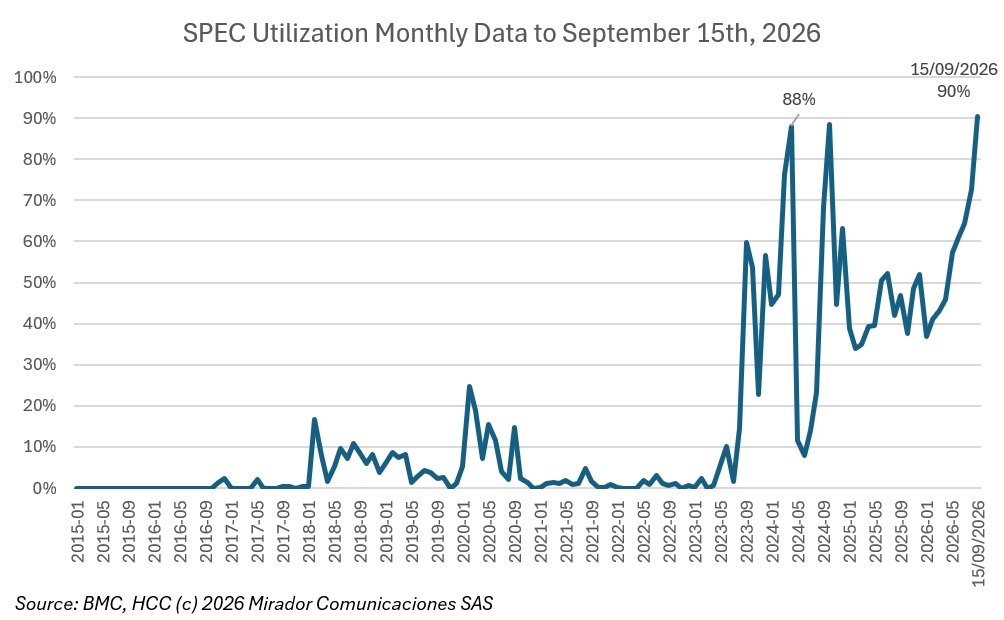
Calamarí LNG and SPEC LNG announced they’ve received their 200th liquefied natural gas cargo from Trinidad and Tobago, bringing cumulative imports to 12.8 million cubic meters – equivalent to 265 TBTU injected into the National Transport System – at a moment when El Niño’s impacts are threatening electricity supply reliability.
The national government approved a modification to SPEC LNG’s environmental license in Cartagena, adding 58 mmcfd of natural gas capacity to strengthen the country’s supply.
Nearly two weeks after Colombia’s August 10 earthquake, natural gas reconnection remains incomplete across the hardest-hit regions, with roughly 10,100 users still without service as of August 14, according to Naturgas president Luz Stella Murgas, speaking from the ANDI Congress in Cartagena.
Colombia’s natural gas production fell 12.9% year-on-year in May 2026, to 1,129 million cubic feet per day (mmcfd) from 1,296 mmcfd in May 2025, with the decline attributed to Casanare, Sucre, Boyacá, and Córdoba.
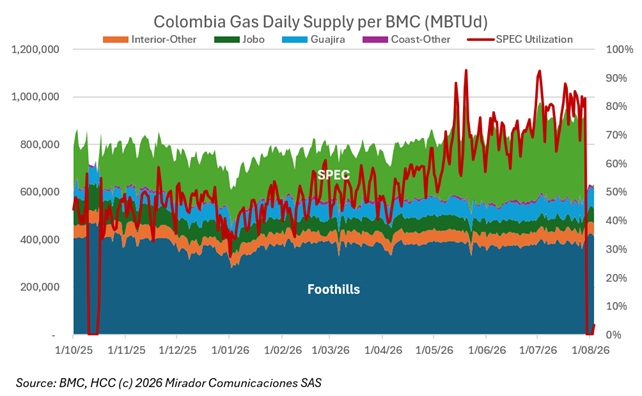
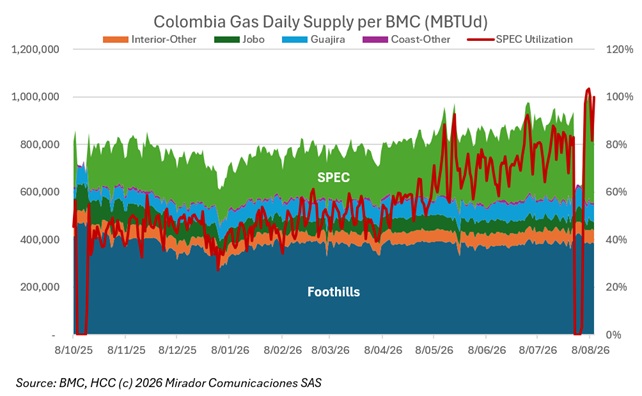
By now you must know that we made it through the SPEC maintenance window without regulated customers noticing anything and no power blackouts. If we hadn’t, you certainly would have heard about it.

2026, Hydrocarbons Colombia, All Rights Reserved.
