

Luz Stella Murgas, president of the natural gas industry association Naturgas, used a detailed interview published in El Tiempo on July 6 to map what she called a “critical juncture” in the Colombian gas sector and to set out the five priorities she says cannot wait beyond the first hundred days of the De la Espriella administration.
Cerro Matoso, the ferronickel producer in Córdoba owned by CoreX following South32’s exit, confirmed on July 1 that it has reduced operations by 25% due to gas supply restrictions already imposed by Canacol — a cut the company says puts hundreds of direct jobs and contracts with local suppliers and contractors at risk, along with royalty and tax flows to both the department and the national treasury.
More than one million Colombian families still rely on firewood or charcoal for cooking — among the most polluting and health-damaging combustion sources in daily domestic use — and Ecopetrol’s Gas Social program exists to close that gap one network connection at a time.
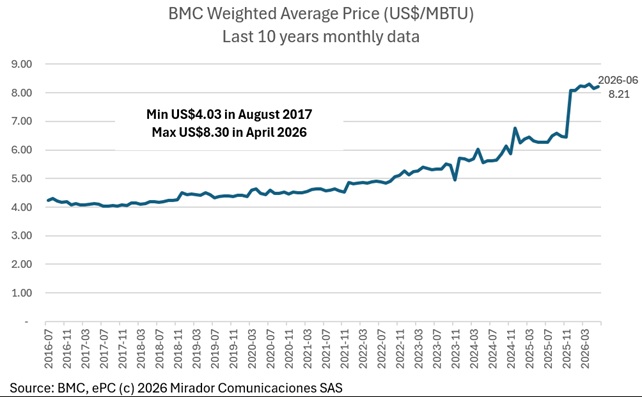
The El Niño weather phenomenon means less water behind hydro dams, less hydroelectricity produced and more need for gas-powered thermoelectricity. That plus the need to import LNG means gas prices should be going up.
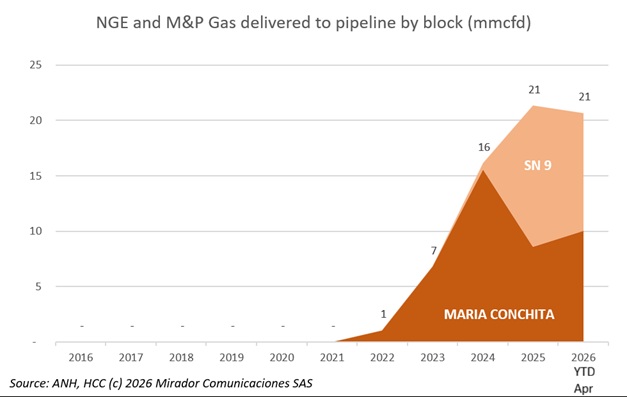
NG Energy International Corp. reported on July 2 that Magico-2X — the second well in its six-well 2026 drilling campaign at the Sinú-9 block in northern Colombia — was spud on June 26, targeting the Pre-CDO–San Cayetano formation as its primary objective.
Colombia’s third LNG regasification project reached a visible construction milestone in late June when the Sociedad Portuaria Regional de Buenaventura received 30 heavy components — individual pieces weighing between 37 and 76 tonnes — destined for the regasification facility being built in Buga, Valle del Cauca.
Colombia’s energy regulator CREG released an infographic guide explaining how it will manage the continuity of liquefied petroleum gas (LPG) public distribution service under its PERP/PC regulatory project framework, a process designed to ensure that LPG infrastructure remains operational when existing operators cannot or will not continue executing a project.
The incoming de la Espriella government’s stated ambition to expand oil and gas production is the easy part of its energy agenda — the hard part is bridging the supply gap before new production arrives.
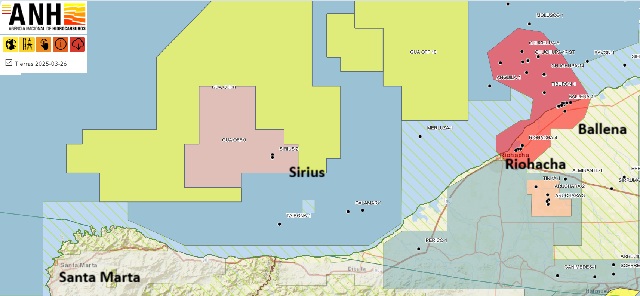
Petrobras has confirmed that it has completed the advance commercialization of the full volume of natural gas corresponding to its participation in the offshore Sirius project, developed jointly with Ecopetrol in the Colombian Caribbean.
Colombia’s energy regulator CREG took a concrete step toward regulating hydrogen injection into the national gas transport network on June 24, hosting a sector workshop and publishing two technical studies on the economics and engineering of hydrogen-natural gas blending (H2+CH4) in the Sistema Nacional de Transporte (SNT).

2026, Hydrocarbons Colombia, All Rights Reserved.
