

The prospective end of the US-Iran conflict and the expected reopening of the Strait of Hormuz have sent crude prices sharply lower, with Brent falling into the US$70s per barrel, levels not seen since before the outbreak of hostilities.
Ecopetrol and Germany’s development cooperation agency GIZ signed an agreement on June 19 to conduct feasibility and engineering studies for a Power-to-Liquid pilot plant at the Cartagena refinery, aimed at producing e-SAF — electronic Sustainable Aviation Fuel — from green hydrogen.
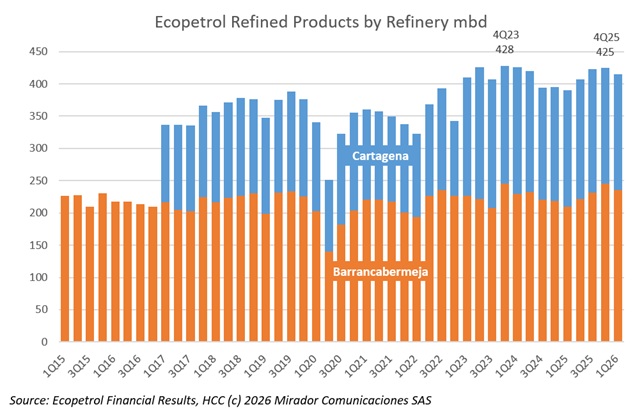
Ecopetrol has completed its first direct export of petroleum coke (petcoke) to Japan, shipping 50,000 tons to a Japanese steelmaker for use in vehicle production, a transaction that represents 5 percent of the Refinería de Cartagena’s total annual petcoke exports and marks a strategic shift in how the state oil company commercializes one of its industrial byproducts.
Jorge Enrique Bedoya, president of the Colombian Farmers’ Society (SAC), drew a direct line between the Petro government’s restrictions on oil and gas exploration and the country’s dependence on imported fertilizers, arguing that greater domestic gas production could have enabled Colombia to manufacture urea at home rather than buying it from Trinidad and Tobago, the United States, China, and Russia.
Colombia’s May 2026 headline inflation rose to 5.84%, according to DANE, with the main drivers in rental housing, water supply, food, and restaurants. Within the utilities subcomponent, however, gas performed strikingly differently: residential gas prices rose just 0.45% month-on-month, contributing a negligible 0.01 percentage points to overall inflation.
Liquefied petroleum gas (LPG) — the propane-butane blend sold in cylinder form in Colombian homes — is emerging as an increasingly strategic energy source at precisely the moment the country’s natural gas supply is under the greatest pressure it has faced in years.
Colombia’s crude oil exports hit their highest level since July 2022 in April 2026, reaching US$1.62B for the month — a surge driven not by increased output but by Iran War-driven price strength in international markets.
The Iran War brought a welcome boost to oil prices that will benefit E&Ps throughout this year and into next. But will it also spur an end to the Internal Combustion Engine which has dominated transportation (and other applications) for over a century?
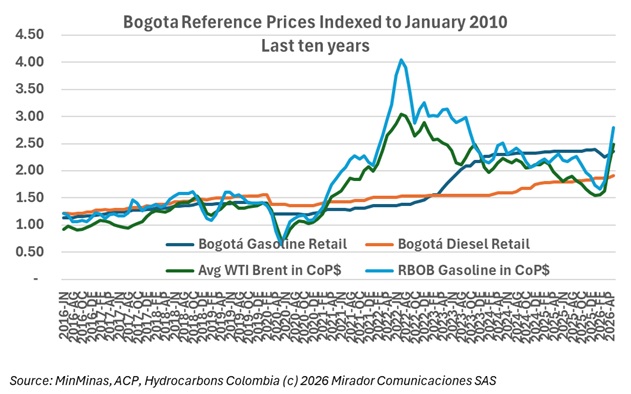
Colombia’s Ministry of Mines and Energy is evaluating a fresh increase in the pump price of gasoline for June 2026, minister Edwin Palma confirmed in public
So earnings season comes to an end and, apart from a few special charges, a generally positive one. Brent over US$100/bl will do that. But, unsurprisingly perhaps, that is not what people are talking about

2026, Hydrocarbons Colombia, All Rights Reserved.
