

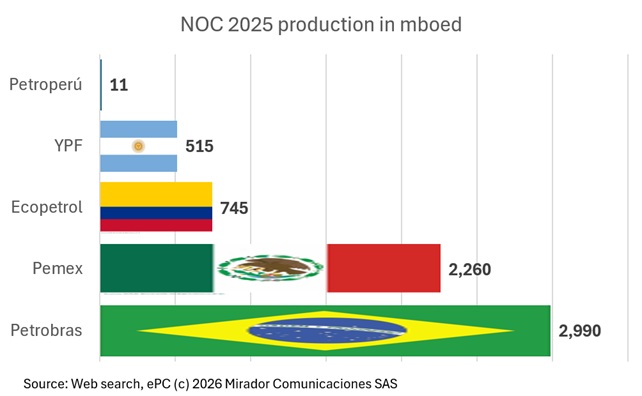
Higher oil prices and solid operational performance will not automatically translate into stronger credit quality for Latin America’s state-owned oil companies, according to a Moody’s report.
Naturgas president Luz Stella Murgas publicly rejected statements made by Colgas’s chief executive – who had told media that natural gas prices would increase – describing the claims as “imprecise and without technical basis” that create unnecessary confusion and misinform users.
Colombo-Venezuelan petrochemical company Monómeros Colombo Venezolanos S.A. has been rescued from insolvency after the Superintendency of Companies confirmed a reorganization agreement in hearings held on July 3 and 10, ending a sixteen-month legal process that began when Supersociedades initiated ex officio reorganization proceedings in March 2025 following a financial deterioration that threatened the company’s viability as a going concern.
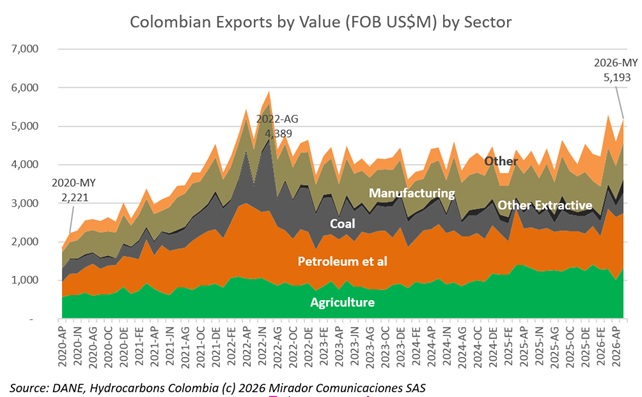
Colombia’s total exports reached US$5.193B in May 2026, a 19.2% year-on-year increase, capping a strong January-May period in which cumulative export revenue hit US$23.588B – up 15.4% over the same period in 2025.
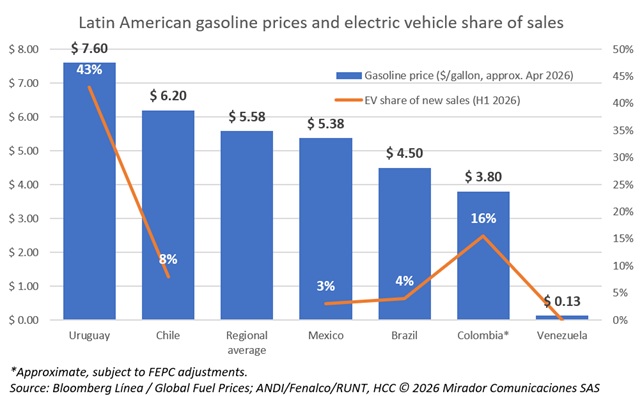
The conventional explanation for Latin America’s electric vehicle boom, as Bloomberg Línea documented for Uruguay this month, is straightforward: when gasoline costs US$7.60 a gallon – the highest in the region – the economics of switching to electric become irresistible.
The Port of Tumaco on Colombia’s Pacific coast received a shipment of 103,000 barrels of fuel from the Cartagena refinery on June 20, in what Minister of Mines and Energy Edwin Palma framed as the reactivation of a strategic logistics node that will diversify fuel supply routes for Nariño and the country’s southwestern departments.
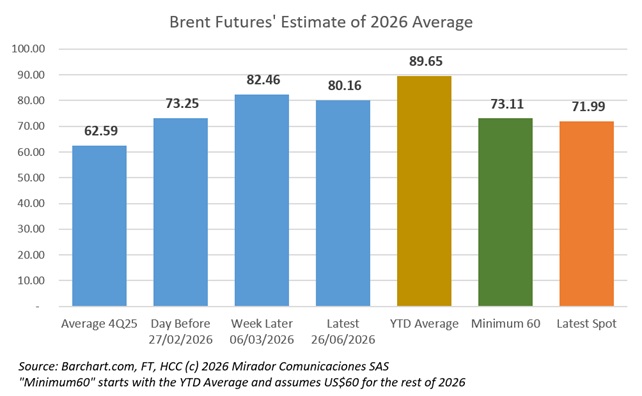
As we write this article, on Tuesday, June 30th, Brent is US$72.99 a barrel on FT.com. Who knows where it may be when you read this, likely some time on Wednesday, July 1st?
The prospective end of the US-Iran conflict and the expected reopening of the Strait of Hormuz have sent crude prices sharply lower, with Brent falling into the US$70s per barrel, levels not seen since before the outbreak of hostilities.
Ecopetrol and Germany’s development cooperation agency GIZ signed an agreement on June 19 to conduct feasibility and engineering studies for a Power-to-Liquid pilot plant at the Cartagena refinery, aimed at producing e-SAF — electronic Sustainable Aviation Fuel — from green hydrogen.
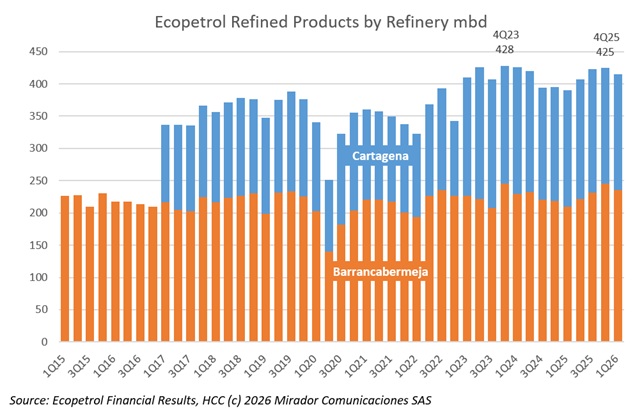
Ecopetrol has completed its first direct export of petroleum coke (petcoke) to Japan, shipping 50,000 tons to a Japanese steelmaker for use in vehicle production, a transaction that represents 5 percent of the Refinería de Cartagena’s total annual petcoke exports and marks a strategic shift in how the state oil company commercializes one of its industrial byproducts.

2026, Hydrocarbons Colombia, All Rights Reserved.
