

Colombia has established a new maritime fuel supply route to the southwestern Pacific coast, with 40,000 barrels of domestically produced diesel arriving in the department of Nariño for the first time via the Pacific Ocean.
The ministries of Finance and Mines and Energy published a draft resolution on March 30, 2026 establishing a new methodology for calculating the producer price of ACPM (diesel) sold to private, diplomatic, and official vehicles — the segment that does not benefit from the subsidies that apply to freight transport.
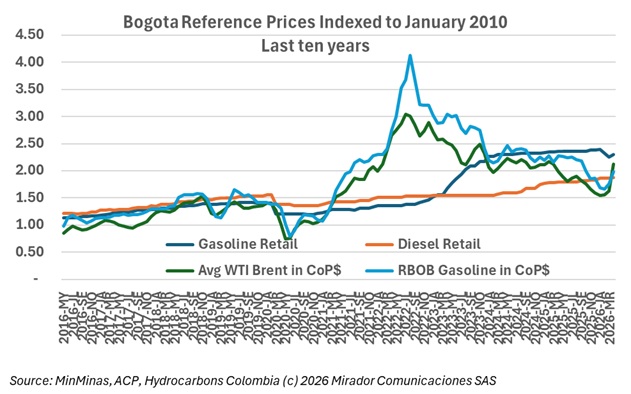
Colombia’s fuel pricing pendulum reversed course on April 1, 2026, as the Comisión de Regulación de Energía y Gas (CREG) issued Circular 260 authorizing an increase of approximately CoP$375 per gallon in regular gasoline — ending a two-month relief period during which the government had cut prices twice, each time by CoP$500, for a cumulative reduction of CoP$1,000.
Three Bloomberg Línea analyses published in mid-to-late March paint a nuanced and cautionary picture of how the Middle East conflict’s energy price shock is landing across Latin America — one in which the instinct to read rising oil as a regional windfall is increasingly being challenged.
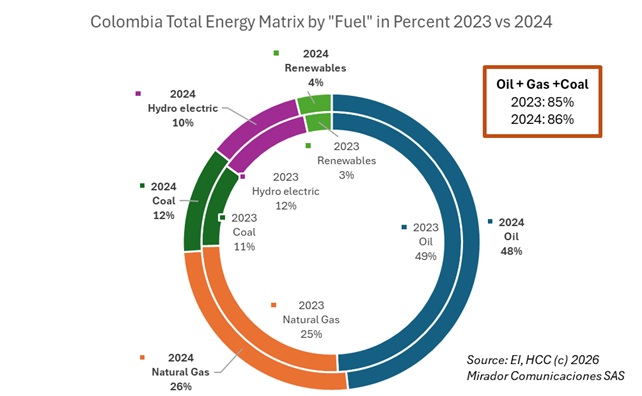
Ecopetrol has pushed back against the more optimistic timelines attached to Colombia’s energy transition, publishing a forward-looking assessment – based on UPME data – that liquid fossil fuels will remain essential to the country’s energy matrix through at least 2040, even under transition scenarios, and that gasoline in particular is heading toward significant import dependence.
A post-mortem analysis by Asoenergía – the Colombian Association of Large Industrial and Commercial Energy Consumers – of the October 2025 maintenance shutdown of the SPEC LNG regasification terminal in Cartagena has revealed how poor supply planning drove residential gas contract prices to nearly three times their normal level in just a matter of days.
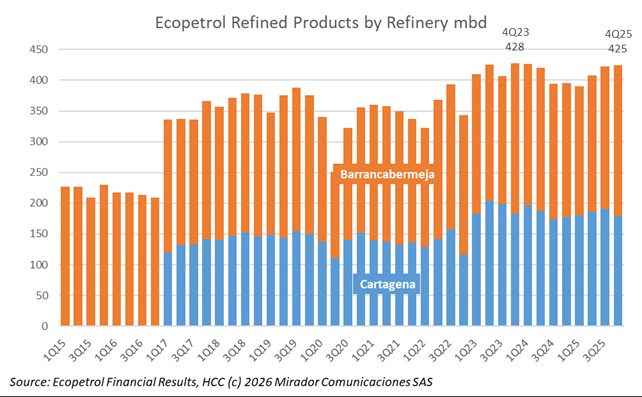
The Refinería de Cartagena (Reficar) returned to normal operations by March 24, 2026, nine days after an electrical supply failure struck the facility on March 15. Ecopetrol confirmed that all processing units are operating normally and that the supply of refined fuels to the national market was maintained throughout the incident.
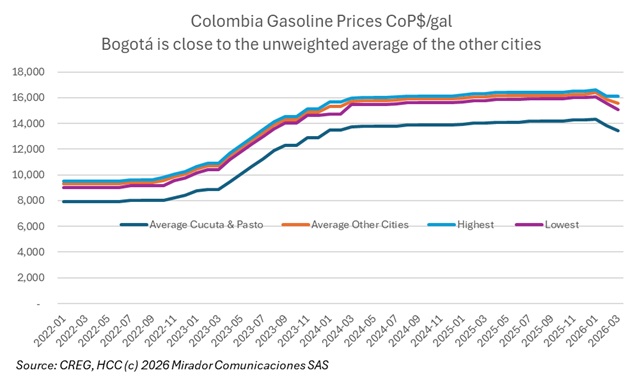
We are rebuilding our fuel price database to capture more information while making it easier to update. Here is the first new chart, gasoline prices by city over time, here summarized to make it easier to read.
Writing on X on March 22, 2026, President Gustavo Petro outlined his government’s response to the prospect of oil prices climbing to US$180/barrel by May – a scenario flagged by Saudi Arabia – placing Ecopetrol at the center of a new fertilizer subsidy mechanism while firmly closing the door on gasoline subsidies.
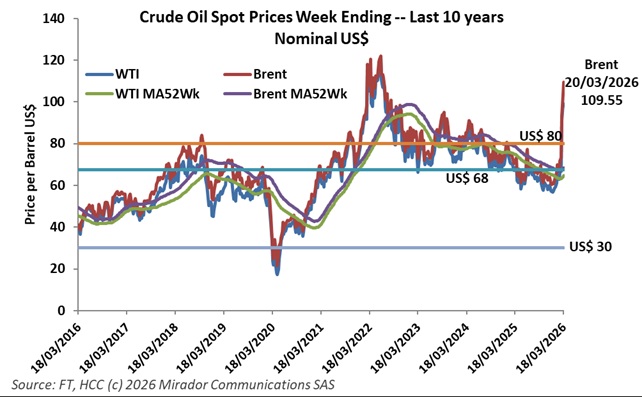
Some readers may think we are ignoring the sector’s most important news: the Iran War and its impact on oil prices. Instead, we worry about reporting things you already know, especially those that are widely reported global stories. Here we update our price charts for those who use them and try to make relevant Colombia-specific comments on what are rapidly changing events.

2026, Hydrocarbons Colombia, All Rights Reserved.
