

As reported by newspaper El Nuevo Siglo, according to the Central Bank (Banco de la República), US$11.411M of the US$13.988M invested by foreigner entrepreneurs in Colombia between January and October 2012, were directed to the mining and hydrocarbons industries. These two sectors offer the greatest growth of foreign investment in the country.
The Ministry of Agriculture and Rural Development reported that the government will allocate CoP$107B (US$59M) in royalties to fund projects in science, technology and innovation. These projects are aimed at foods like avocado, cocoa, milk, coffee, sugarcane, and fruits, and matters of farming, bioenergy, fisheries and promising species.
Prior Consultation is a constitutional right of Colombian ethnic groups. This right requires them to be consulted before the development of projects that may impact their sacred territories. However, many indigenous groups complain that neither the government nor the oil and mining companies respect this right
We had lunch last week with Rafael Nieto, lawyer, ex-vice minister of justice in the Uribe government, ex-president of Greystar/Eco Gold, newspaper columnist and founder of the firm NSG which helps companies with issues of community relations and environmental permits.
The Colombia-Canada Chamber of Commerce invited the Interior Minister to speak at lunchtime during their Dialogue Canada event. A last minute request by the President pulled Fernando Carrillo out of the event and his Vice Minister for Participation and Equality, Anibal Fernandez de Soto spoke instead. Fernandez de Soto’s role includes responsibility for the community prior-consultation process, which has much of the hydrocarbons industry concerned. His remarks were woven around the Farc peace process, both the current negotiations and the post-conflict phase.
Earlier we reported that Maurel & Prom have come under fire for seismic testing in Boyacá. Residents claim that explosive charges damaged houses and ruptured water pipes, leaving residents of one municipality without water for five days. National radio network W Radio took up the residents’ cause and made the story a central part of its morning program, which enjoys the country’s highest audience rating. Today at the Colombia-Canada Chamber of Commerce’s Dialogue Canada event, National Hydrocarbons Agency (ANH) head Orlando Cabrales Segovia gave his point of view.
The following is a list of the 12 patents that Ecopetrol has obtained so far in 2012. Seven of these patents have been granted in Colombia, two in Russia and 3 in Mexico:
As reported by the website dinero.com, the number of visitors from Asian countries to Colombia increased significantly in 2012. Compared with the same period of 2011, the Finnish visitors increased 57%, 35.2% Chinese, Koreans 31% and Japanese 26.9% so far in 2012. This is because trade relations with these countries have considerably strengthened through the work of the Ministry of Commerce, Industry and Tourism.
MILA (Integrated Latin American Market) is the alliance between the stock exchanges of Colombia, Peru and Chile. Of the 861 companies that are part of MILA (Integrated Latin American Market) Ecopetrol is the only Colombian company that reached the international standard for corporate transparency.
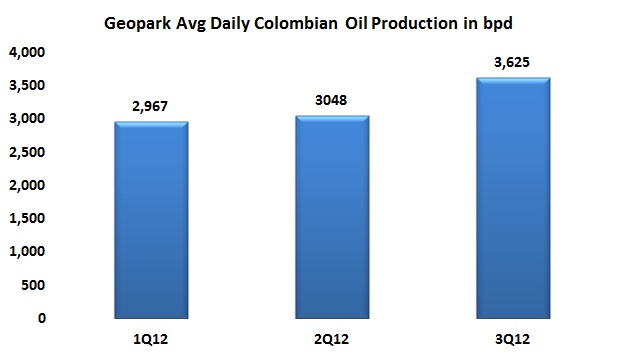
Chilean company GeoPark reported its 3Q12 operational results which highlighted the importance of the company’s acquisitions in Colombia this year. (It bought Winchester Oil & Gas in January and Hupecol in March.) This quarter these new Colombian assets produced more oil than did GeoPark’s principal assets in Chile. However, Chilean operations produced over 21,000 MCFPD which when translated into equivalent barrels of oil meant the home country still lead in boepd.

2026, Hydrocarbons Colombia, All Rights Reserved.

