

Russian president Vladmir Putin made his nation’s support for the peace process in Havana official this week during the sixth BRICS Summit held this week in Brazil’s capital of Brasilia. Putin’s support is thought to bring a symbolic counterweight to the table as a force that could have greater weight with the Farc guerrillas.

After a bad week in the previous period, incidents went down to 34, still above recent and long-term averages.
Recent surveys have found a substantial increase in optimism in Colombians towards the progress of the country. While some of this could be the fabled “World Cup Euphoria” the peace process was listed as a prime motivator for a better outlook.
After the recent pipeline attacks and simultaneous lowering of the government’s production target to 981mbd, MinMinas Amylkar Acosta and Colombian Petroleum Association (ACP) head Alejandro Martínez separately did the rounds of the national press. Both provided some interesting statistics and perspectives.
Over the past few weeks, the focus of environmental criticism has shifted from the oil companies themselves to the impact of crude spills from guerrilla attacks on infrastructure. But E&P companies are not completely off the hook.

Both guerrilla kept up the pressure this week as incidents went up to 38, above recent and long-term averages.
A convoy with nearly two dozen tankers full of crude were stopped on their way to Ecuador by the Farc and forced to open their valves. The tankers were following an alternative route that has been proposed as a safer option to shipping the crude via truck or pipeline across Colombia.
The peace process received words of support from some big names this week, from former world leaders to a multi-denominational group of religious leaders, but the security conditions needed on the ground to continue with the talks receives its fair amount of questions at home.
The ELN guerrilla staged a devastating attack on the Coveñas/Caño Limon pipeline on Sunday which is leading many to question the government’s strategy of holding peace talks without guarantees of a cease fire.
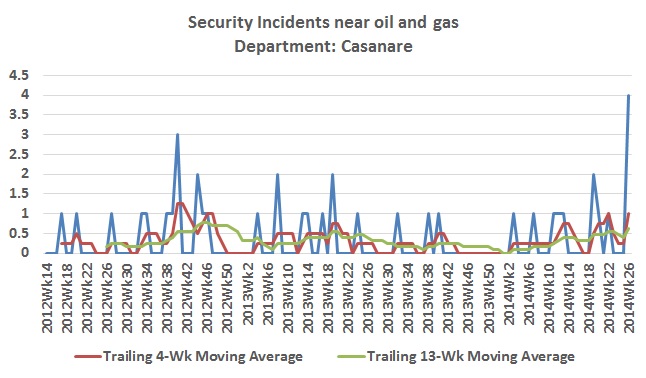
The department of Casanare has felt an uptick in attacks which have included selective targeting of individuals, burned tanker trucks and leaflets threatening an “armed strike” by the ELN guerrilla as its 50 year anniversary approaches on the 4th of July.

2026, Hydrocarbons Colombia, All Rights Reserved.
