

The Attorney General Eduardo Montealegre ignited controversy and rejection from the government this week after telling a forum that the authorities should close judicial cases against guerrilla members and not press for jail time.

The count dropped this week to 39, above long-term averages but below the recent average and the shift in geographic distribution continues.
Strange messages coming in and out of the email account of the government’s lead negotiator Humberto de la Calle tipped authorities off to electronic eavesdropping of his account. De la Calle charges that forces are at work to sabotage the peace talks.
The National Hydrocarbons Agency (ANH) says it held a meeting with the Ministry of Defense, Interior ministry, police and military forces and industry representatives to improve the scenario in the areas of influence of hydrocarbons projects.
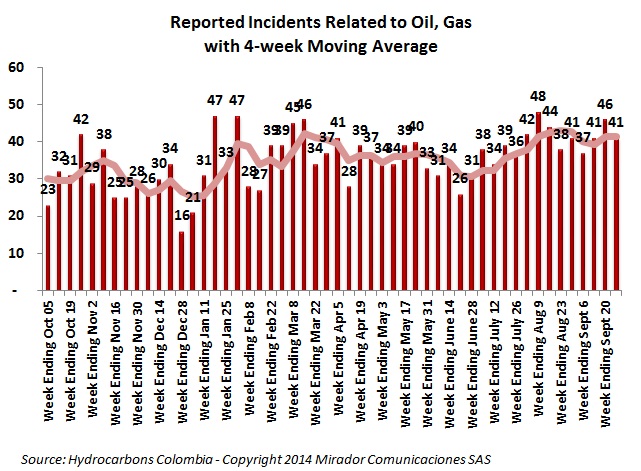
The count dropped this week to 41, above long-term averages and slightly below the recent average, but new threats have appeared with implications for the post-conflict scenario.
After more than a month of protests from the Tesoro de Bubuy village in Aguazul, Casanare, oil operator Perenco has issued a statement to local media contesting allegations by protesters, which it says are merely a tool to obtain greater concessions from the company despite past agreements.
In an about face, the government released the draft texts of the three agreements reached thus far with the Farc in Havana, Cuba, in a move to silence critics of the peace process.
The Interior Ministry has signed a series of agreements with Putumayo residents, who have agreed to lift blockades and stop protests that have dogged the region for more than two months. The agreement followed a tentative accord two weeks ago.
An attack that left two oil contractors working on a section of the Coveñas/Caño Limón pipeline dead underscores an alarming increase in attacks not only against the oil industry’s infrastructure, but its workers as well.

The count jumped 12% this week to 46, above recent and long-term averages, but, except for a particularly bad incident, the increase was mostly Armed Forces activity.

2026, Hydrocarbons Colombia, All Rights Reserved.
