

The Interior Ministry has signed a series of agreements with Putumayo residents, who have agreed to lift blockades and stop protests that have dogged the region for more than two months. The agreement followed a tentative accord two weeks ago.
An attack that left two oil contractors working on a section of the Coveñas/Caño Limón pipeline dead underscores an alarming increase in attacks not only against the oil industry’s infrastructure, but its workers as well.

The count jumped 12% this week to 46, above recent and long-term averages, but, except for a particularly bad incident, the increase was mostly Armed Forces activity.
The 28th round of talks finished at the end of last week, while a national forum for victims included commentary from Colombians displaced by the conflict and living around the world.
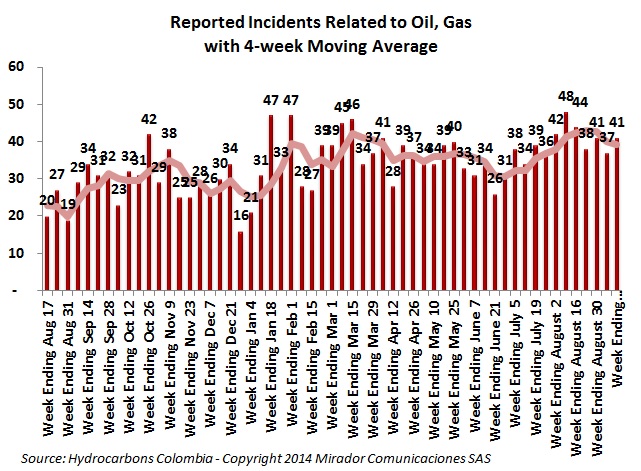
The count increased to 41 this week, above recent and long-term averages, but the story was a direct attack on the electrical substation of a field.
The second group of 12 victims of Colombia’s armed conflict addressed the peace talks in Havana, calling for a bilateral cease fire and that justice, but not revenge, is served.
After nearly two months of protests in Putumayo the government has agreed to form a permanent dialogue with the department in the Puerto Asís in order to find a solution to end the ongoing dispute where oil infrastructure and security is a principal issue.

The count dropped to 37 this week, below recent but above long-term averages, and took the trend line with it but the distribution of incidents was the most unexpected.
A contentious tone fell over the process in the past week as the Farc denied that the process was advancing towards a final stage, and unleashed a flurry of controversy after comments on the victim status of congressional representative Clara Rojas, once a captive of the guerrilla.
Arauca congressional representative Albeiro Vanegas says that the ELN has stepped up attacks in the department, while the Farc has decreased activity. The congressional president José David Name has called on greater security measures from the government.

2026, Hydrocarbons Colombia, All Rights Reserved.
