

The first round of talks in 2015 started on Monday, kicking off what President Juan Manuel Santos describes as “the most difficult stage” of the talks, as the issue of how to structure a post-conflict transition becomes the focus.

The Farc’s unilateral truce appears to be holding – despite the strains caused by continued government bombardments – as our measure of guerrilla-initiated incidents fell even though the total count was up one from last week to 28.
Farc commander Rodrigo Londoño Echeverri, alias ‘Timochenko’ criticized the government and called for a transitional process that is applied equally to former guerrilla members and the armed forces.
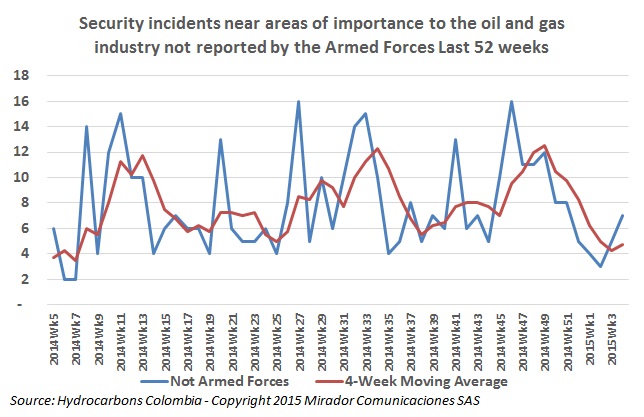
The ELN played a leading role as the overall count increased once again to 27 this week (below the long-term average but above recent averages), driven mostly by an increase in non-Armed Forces-reported incidents.
The Attorney General Eduardo Montealegre sparked a debate this week after he said that a referendum to approve an eventual peace agreement is not necessary, not from a constitutional nor legal standpoint. Instead the government has the power to pass the agreements as a Public Order Law, a power which was renewed by congress last year.

The geographic band from Cauca through Huila and into southern Meta and northern Caqueta continues to be a concern. The overall count increased to 24 this week, below the long-term average but above recent averages.
A seismic exploration program that kicked off in November in Putumayo has divided the Awa and Nasa indigenous groups, with the later fiercely opposed and the Awa in favor, and led to physical confrontations and a suspension of exploration activities.
President Juan Manuel Santos said via a televised address that he has told his negotiators to start discussing an indefinite bilateral cease fire with the Farc, and assured that 2015 “could be the year that the conflict stops”.

The overall count increased to 24 this week, below recent and long-term averages but non-Armed Forces reported incidents declined. This means the increase was due to Army-related activity.

The overall count decreased again to 18 this week, below recent and long-term averages. This week both Armed Forces and non-Armed Forces reported incidents declined.

2026, Hydrocarbons Colombia, All Rights Reserved.
