

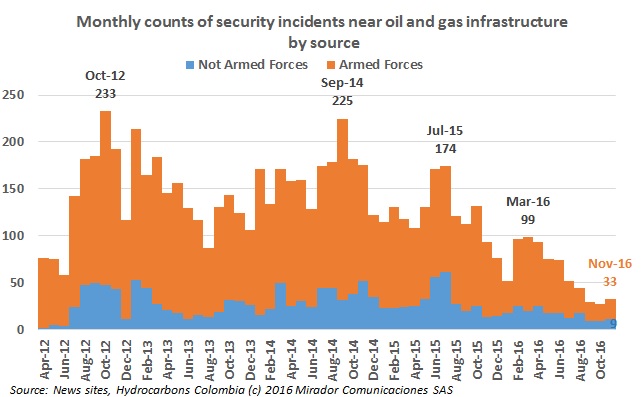
Our count of security incidents near oil and gas infrastructure went up last month, about equally divided between those we ascribe to the guerrilla and those initiated to the Armed Forces.
Colombia’s Senate and Chamber of Representatives have approved the revised peace agreement between the government and the Farc. The main opposition to the agreement, the Centro Democratico, abstained from the vote, and government officials urge a quick implementation of the accord.
Ecopetrol (NYSE) said that November has brought an “onslaught” of attacks and illegal valves affecting the Transandino and Coveñas/Caño Limon pipeline, part of an increased pace of incidents over the last two months.
As of this writing on Thursday, November 24 Farc and government representatives were set to sign the revised peace agreement in Bogotá, and submit the document to congress for approval. The ‘no’ opposition is demanding another referendum on the new agreement.
Government negotiators announced a new revised agreement with the Farc last weekend which they say has taken into account 80% of the points sent by ‘no’ supporters, and insisted that there is no more room to negotiate the final agreement.
The political magazine Semana organized a forum called “Restitution transforms lives and builds peace” in Bogotá. HCC was present at the event; we bring a brief summary of the meeting.
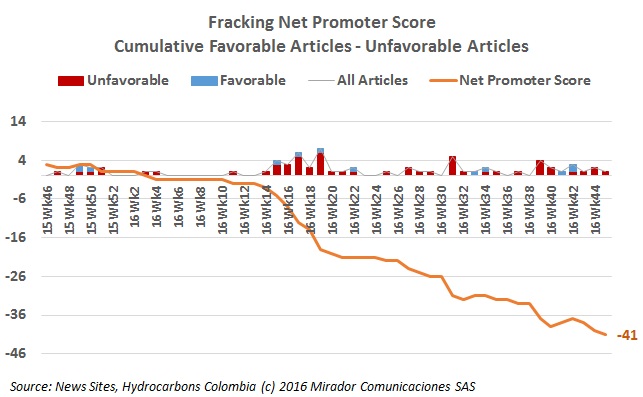
Controversy over ConocoPhillips (NYSE:COP) project in Cesár has brought unconventional technologies back into the press limelight and the balance has not been positive.
The government has compiled proposals from the ‘no’ proponents into 57 different items and is now discussing them with the Farc. Head negotiator Humberto de la Calle said that the discussion in Havana has been difficult, but denied rumors that the Farc had left the table.

From a security perspective, October was essentially the same as September. Better, actually, in terms of total counts but that was only because the Armed Forces recorded 2 fewer incidents.
Among the proposals sent to the National Planning Department (DNP) as part of the royalty budget discussion by the Colombian Petroleum Association (ACP) is a mechanism to penalize communities whose frequent protests paralyze the oil industry.

2026, Hydrocarbons Colombia, All Rights Reserved.
