

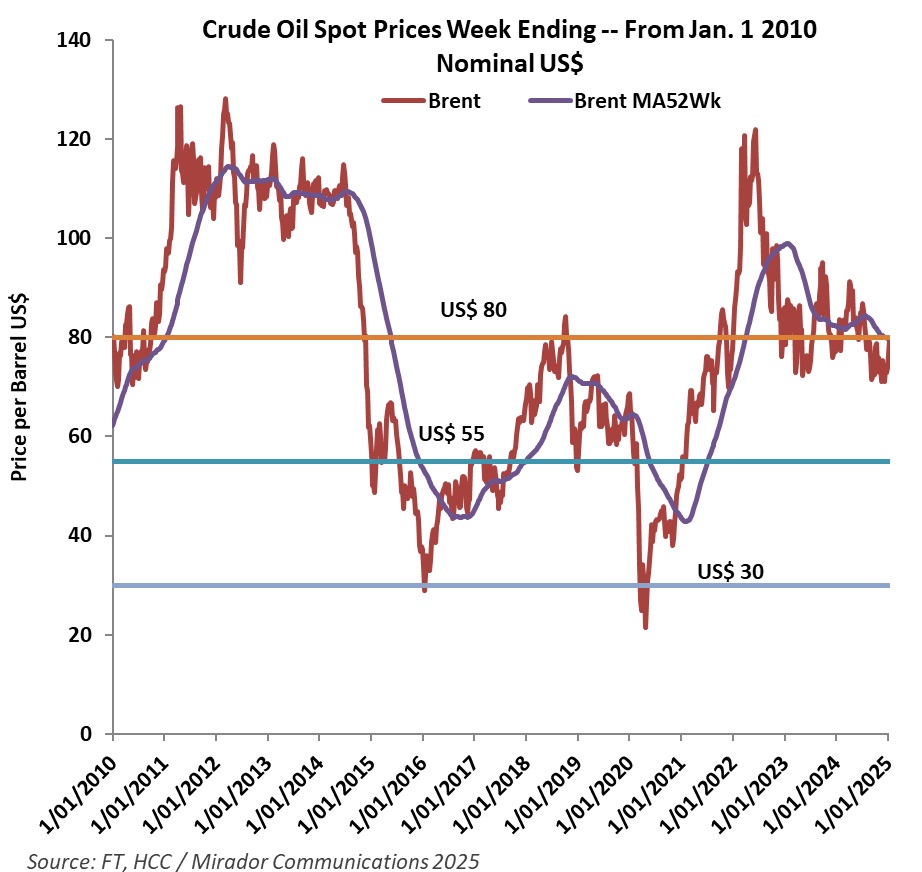
Time for our annual predictions article. Mostly focused on quantitative measures of the industry – prices, Capex, reserves, production – but also some comments on policy issues for 2025.
The Colombian Ministry of Mines and Energy (MinEnergia) unveiled a draft decree formalizing the merger of the National Hydrocarbons Agency (ANH) and the Institute for Planning and Promotion of Energy Solutions for Non-Interconnected Zones (IPSE).
The Escazú Agreement, adopted in Costa Rica in 2018 and ratified in Colombia under Law 2273 of 2022, represents a landmark step in promoting environmental justice and transparency in Latin America and the Caribbean. It places citizens at the forefront of environmental protection, ensuring their rights to information, participation, and justice in ecological matters.
In a landmark ruling, Colombia’s Constitutional Court has determined that Environmental Impact Assessments (EIAs), as regulated by Article 57 of Law 99 of 1993, must now include evaluations of climate change impacts.
The Colombian government, led by President Gustavo Petro, is facing criticism for its delay in disbursing funds for subsidies on liquefied petroleum gas (propane), which are essential for low-income families in rural areas.
The National Authority of Environmental Licenses (ANLA) has granted an environmental license for the exploratory offshore oil drilling project in the Col-1 Block, located in Colombia’s Caribbean.
Colombian industrial leader Bruce Mac Master, President of the National Business Association of Colombia (ANDI), voiced strong criticism of the government’s handling of the natural gas supply crisis.
The Government’s financing bill proposes a five-percentage-point increase in the income tax surtax for oil exploration, raising it from 15% to 20%. The Colombian Petroleum and Gas Association (ACP) voiced strong opposition to the proposed increase.
Mario Alberto Huertas, President of MHC Ingeniería y Construcción de Obras Civiles, emphasized the need for better coordination and support from government entities to overcome persistent challenges in infrastructure projects across Bogotá.

A report by Promigas highlights significant findings in Colombia’s hydrocarbon sector, revealing that offshore reserves could be 20 times greater than onshore reserves.

2026, Hydrocarbons Colombia, All Rights Reserved.
