

Senator Julio Miguel Guerra Sotto has submitted a bill to create a formal social license for mining operations, a measure that other authorities and lawmakers have suggested for the hydrocarbons industry,
The director of the DNP Simón Gaviria Muñoz visited Yopal, Casanare to meet with local authorities and deliver a message that the government plans to get to the heart of the regions’ dissent and address royalty compensation.
The national government has issued a decree that sets requirements on local hiring for the hydrocarbons industry, obliging oil companies to hire municipal residents for both skilled and unskilled labor positions.
The legislative bill that bring on the first major changes to the General Royalty System (SGR) since its enactment two years ago has passed its first senate debate.
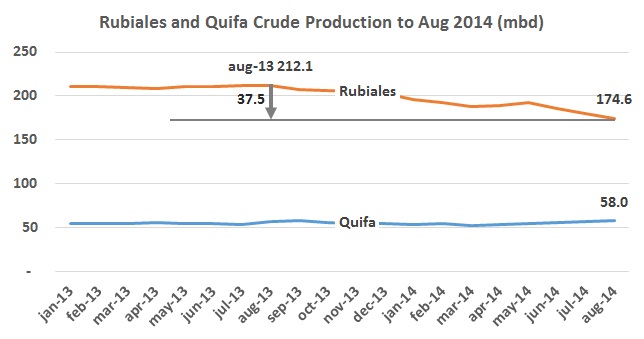
When last we left Rubiales and Quifa it was a real ‘cliff-hanger’. Rubiales field had issues with produced water and partners Pacific Rubiales (TSX:PRE) and Ecopetrol (NYSE:EC) had decided to shut down the STAR test at Quifa. A few months later, recently published ANH figures tell us what happened next.
Industry associations from the mining, energy and infrastructure sectors have elaborated a joint document for the government that offers proposals to alleviate problems associated with prior consultation requirements, which industry representatives say are putting at risk key projects.
The Minister of Mines and Energy Tomás Gonzalez said the government’s current formula to set the price of gasoline and diesel is working and no new fuel law is being considered. The transportation industry reacted calling for a review of the formula and taxes.
The Labor Minister Luis Eduardo Garzón went to Yopal, Casanare to discuss a new law that would limit the role of the Community Action Committees (JAC) in the hiring of local skilled and unskilled labor for the oil industry. Local leaders however accused the government of only tending to the interests of the oil companies.
The Ministry of Environment (MinAmbiente) published the decree 2021 of October 15, 2014, the document which establishes new timeframes for the decision making process that leads to an environmental license.

Interoil (OL:IOX) says that the National Hydrocarbons Agency (ANH) wants to terminate two of its production licenses for the LLA-47 and COR-6 blocks over unpaid bank guarantees and breach of contract. The company says that in COR-6 social and environmental conditions make work impossible.

2026, Hydrocarbons Colombia, All Rights Reserved.
