

After defending the decree which restructures the process and deadlines to grant licenses against environmentalists and critics in the Senate, the Minister of Environment Gabriel Vallejo met with members of the oil industry to calm company concerns on the process.

Led by the Finance Ministry (MinHacienda) Mauricio Cárdenas, the central government brought a series of proposals before a joint economic session of congress that it says would increase direct royalties to producing regions to CoP$4.1T (US$1.998B) in 2015-2016 from the previous figure of CoP$1.9T.
Community Action Committees (JACS) from Casanare have organized themselves to reject labor reforms proposed by the Labor Ministry that would sideline their role in local hiring in favor of government-run agencies. In a letter, the JACS said the reform is just as bad as the royalty reform.
Senators and environmentalists continue to scrutinize a change in expedited environmental licenses, making accusations that the decree is a reworking of protected areas and will weaken conservation efforts. MinAmbiente Gabriel Vallejo meanwhile responded in a Senate debate and to the general press.

The government’s fiscal plans are being squeezed by the downward trend of the WTI and Brent oil prices. Estimates are that for every dollar the price drops, the fiscal impact in revenues amounts to CoP$420B (US$220.8M) over the year.
The General Royalty System (SGR) continues to generate conflict between the central government and regional leaders. Departmental governors from the major oil producing regions say a budget crisis is looming due to the new royalty system as congress mulls changes.
A boom in the local population and migratory patterns that has led to increased unemployment, crime rates and now budget problems due to the lack of direct royalties. The Aguazul mayor Fernando Camacho argues that the nearly 15 years of oil activity has left the community worse off.
The Ministry of Mines and Energy (MinMinas) has signed a cooperation agreement with its counterpart in Peru to promote an exchange of information and hold a yearly meeting to discuss hydrocarbons development.
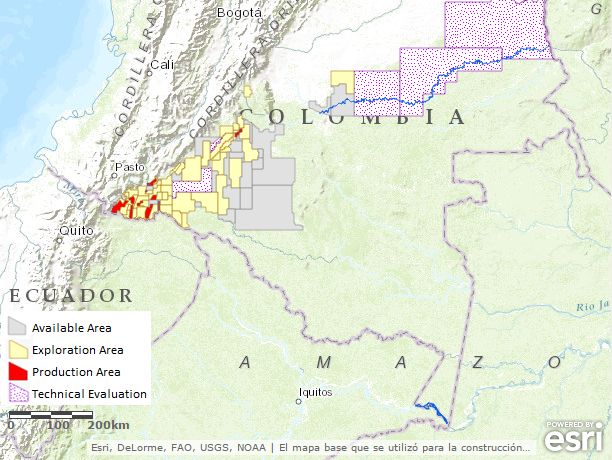
The National Hydrocarbons Agency is making slow advances towards the Amazon basin, which has the potential to greatly increase the country’s proven reserves, but could also ignite conflicts over environmental issues.
Senator Juan Diego Gómez, of the conservative party, wants to hold a debate in the Senate’s Fifth Commission on the issue of fuel quality to analyze issues surrounding Ecopetrol’s (NYSE:EC) refining of fuels in Colombia.

2026, Hydrocarbons Colombia, All Rights Reserved.
