

The incoming De la Espriella government has made enabling unconventional hydrocarbon extraction one of its most explicit energy policy commitments and the outgoing Petro government has moved to make that path as legally difficult as possible with fewer than three weeks left in office.
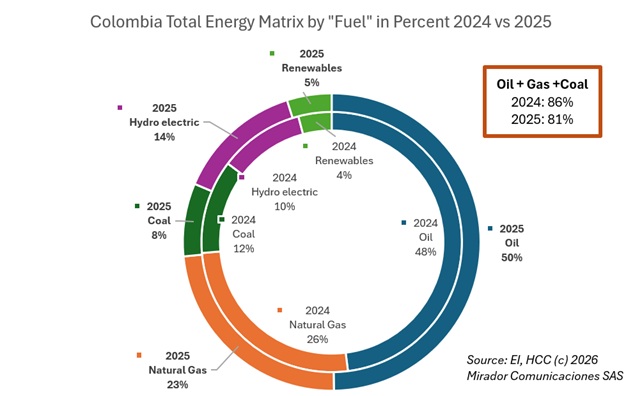
The Energy Institute took over production of the annual Statistical Review of World Energy which BP had produced for decades. This was, in fact, the 75th edition. We find it interesting for the tables and tables of energy data cut every which way that can produce thought-provoking graphs.
A July 4th Semana analysis by its economics desk crystallizes the three converging energy emergencies that will define the de la Espriella administration’s first weeks: El Niño, the Canacol insolvency, and Air-e’s paralysis, each serious on its own, and compounding when combined.
Ecopetrol published its formal El Niño contingency plan on July 9, revealing the most consequential near-term contribution it can make to the national electricity system: two regasification projects that together will add 360 GBTUD of gas import capacity, equivalent to approximately 35% of national gas demand which could support up to 1,000 MW of additional thermoelectric generation through the critical dry season.
Fabio Arjona Hincapié – a marine biologist, former vice-minister of Environment under Ernesto Samper, and until recently director of Conservación Internacional Colombia – was confirmed as de la Espriella’s minister for the Environment and Sustainable Development portfolio that will sit at the intersection of the new government’s hydrocarbons expansion agenda and its stated commitment to environmental protection.
Ecopetrol’s research arm, the Colombian Institute of Petroleum and Energy Transition (ICPET), has launched a new operating model built around “technology suites” dedicated to water conservation, decarbonization, and nature-based solutions, marking a significant expansion of its experimental infrastructure at the El Chircal eco-reserve in Piedecuesta, Santander.
The Petro administration has designated 1.5 million hectares of the Sierra Nevada de Santa Marta as a Renewable Natural Resources Reserve, barring new mining concessions and hydrocarbon exploration and production contracts across the entire area.
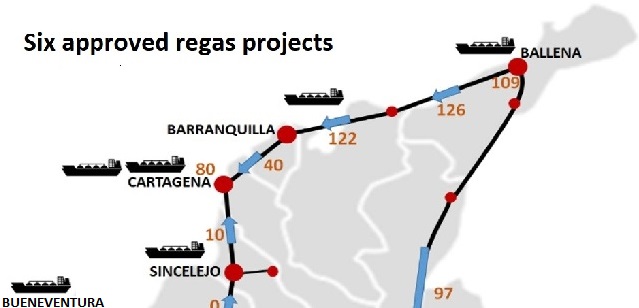
Colombia’s environmental licensing authority ANLA used a June 1 press release to frame its recent activity on liquefied natural gas infrastructure in explicitly strategic terms: the accumulation of approved and pending regasification projects along the Caribbean coast is the country’s most concrete near-term tool for expanding gas supply, increasing competition, and improving prices for end users.
Three senior voices in Colombia’s energy sector used a La República forum panel on May 29 to deliver a coordinated indictment of current energy policy — and a set of prescriptions the next government will need to act on quickly if a blackout is to be avoided in the second half of the year.
The public utilities industry body Andesco issued a formal warning on May 21 that Colombia has a critical and non-extendable window of three to four months to take regulatory and operational action before El Niño drives the country into an energy supply crisis.

2026, Hydrocarbons Colombia, All Rights Reserved.
