

Colombia’s contribution to the extractive industries transparency initiative EITI held a public webinar on June 19 bringing together more than 70 participants from government agencies, civil society organizations, academic institutions, and territorial communities to review progress on the upcoming EITI Colombia National Report 2023-2024 and discuss the broader governance agenda for the mining and hydrocarbons sector.
Deutsche Bank and Corficolombiana both published assessments on June 12 framing the same basic question ahead of Colombia’s June 21 presidential runoff: what comes after the vote, and how durable will any initial market optimism prove to be?
Ecopetrol and Parex Resources donated firefighting equipment to the volunteer fire brigades of San Miguel and Valle del Guamuez municipalities in Putumayo on June 12, under the Acuerdo Empresarial Putumayo, a joint social investment mechanism the two companies operate in the department. The combined investment exceeded CoP$25M.
The Petro administration has designated 1.5 million hectares of the Sierra Nevada de Santa Marta as a Renewable Natural Resources Reserve, barring new mining concessions and hydrocarbon exploration and production contracts across the entire area.
Vaca Muerta is already producing 597,300 bd from the Neuquén basin, representing two-thirds of Argentina’s national output of 885,300 bd — and Luis Barallat, BCG’s director for Iberia and South America, believes that is still early innings.
Parex Resources Colombia used an article in El Espectador to mark its track record under Colombia’s Works for Taxes mechanism — the scheme that allows companies to redirect a portion of their income tax obligations directly into public infrastructure projects in historically underserved regions.
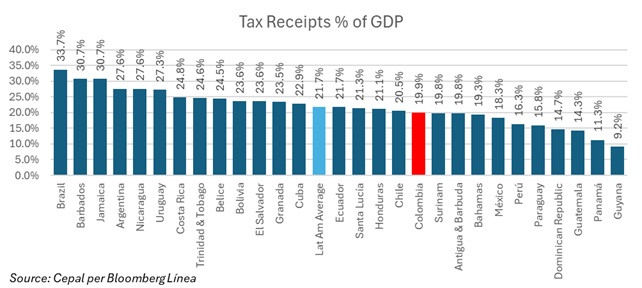
A new CEPAL statistical report on tax collection across Latin America and the Caribbean through 2024 finds a region making incremental progress on revenue mobilization — but still structurally distant from developed-economy benchmarks, and dangerously exposed to commodity price swings in the countries that matter most.
ExxonMobil’s discovery of more than 11 billion barrels of recoverable oil in Guyana’s deep waters over the past six to seven years – described by environmental groups as the largest oil find of the 21st century – has set off a wave of hydrocarbon ambition across the Caribbean basin that civil society organizations are now calling “the Guyana effect.”
Last night, while watching the news on TV, my wife asked me if I supported fracking. Given that her interests are in other fields, I knew the debate has become mainstream.
Four families in the municipality of Orito, Putumayo, have received new homes through Plan Padrino, the corporate volunteering program run by Parex Resources.

2026, Hydrocarbons Colombia, All Rights Reserved.
