

The Colombian Llanos has been one of Colombia’s top producers, especially in Meta. But with slashed investment budgets the region’s main operators and authorities are adjusting to current oil prices in different ways.
Parex invested CoP$22.7B (US$9M) in sustainability projects in 2014 while Equión promotes farming in Yopal. These and other stories on Corporate Social Responsibility (CSR) in our periodic summary.
The Minister of Mines and Energy (MinMinas) Tomás González defended provisions for the mining and oil sector in the National Development Plan (PND) in the Senate’s Fifth Commission, where he and other authorities were questioned on its reach in social and environmental matters.
With its change in strategy Ecopetrol (NYSE:EC) must become a “more international –Panamerican- and definitely more profitable”, especially to log new reserves says its president Juan Carlos Echeverry.
Pacific Rubiales (TSX:PRE) and Ecopetrol (NYSE:EC) are the only Colombia focused operators participating in the historic bidding round that will open the Mexican oil industry to private capital, which has advanced to the next stage.
The USO released a statement denouncing the recent violence between the Farc and the Colombian army and called for an immediate bilateral truce

The Ministry of Mines and Energy (MinMinas) released 2014 reserve figures for oil and gas, and said that the country has proven reserves for 6.4 years considering current production levels.
President Jose Manuel Santos criticized Farc attacks and drained tankers in Putumayo, which provoked one of the largest public rejections of the guerrilla this year. Santos said these acts do not make sense and the guerrilla never will win the respect of the Colombians.
The flare in violence following the end of the Farc’s supposed unilateral cease fire has put pipelines and oil infrastructure back in the crosshairs of guerrilla groups. It could not come at a worse time for Ecopetrol (NYSE:EC) which will see its costs rise and production fall as a result.
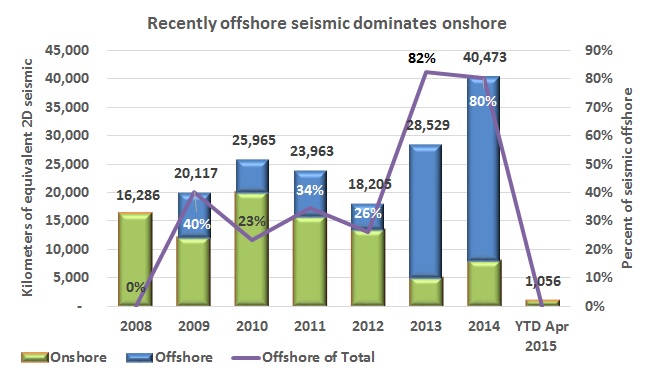
We recently looked at analysis from the Colombian Chamber of Oil Goods and Services (Campetrol) on exploratory wells, which showed the strong impact of the price crisis. For seismic exploration, the picture is even worse.

2026, Hydrocarbons Colombia, All Rights Reserved.

