


The latest unilateral truce only started Monday (July 20th) but both groups did not exactly ease into it with the total count up by 14 to 46, the highest we have recorded this year. The guerrilla increased their activity by 4 (by our methodology) and, after lagging behind in the past few weeks, the Armed Forces increased reported activities by 10.
The Labor Minister Luis Eduardo Garzón said that the increase in guerrilla attacks over the last month, coupled with low oil prices could lead to a loss of between 8-10,000 jobs in the oil industry.
Awaking from an apparent slumber, President Juan Manuel Santos issued his clearest message to the Farc that no agreement can be made without transitional justice.
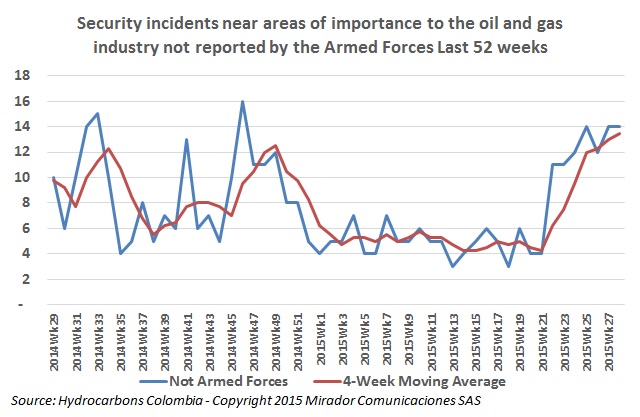
The Farc announced a new unilateral truce but only after July 20th. Meantime, the total incident count was down again to 32 but guerrilla-initiated incidents (by our methodology) were flat and the 4-week trend continued up.
The USO said that the arrests of two community leaders in association with protests in the Rubiales field is the latest judicial frame-up by the industry designed to hurt labor union rights in Colombia.
The Resource Center for Conflict Analysis (Cerac) says that June of this year was the most violent month since the peace process begun three years ago.
The Farc announced that it would put in place a new unilateral cease fire for one month, starting on July 20, after an escalation in violence in the weeks following the termination of its prior unilateral cease fire on May 22.

The total incident count was down again to 33 but guerrilla-initiated incidents (by our methodology) were up by 2 and the 4-week trend continued up.
After nearly two months of blockades in Caquetá over an exploration project by Emerald Energy, tensions have elevated the conflict to a new high after riot police cleared protesters by force last week.
The toll of the latest Farc offensive, one with grave environmental consequences, has shown itself in a recent Gallup poll which found that 46% of Colombians support a military-led approach to defeating the Farc, one percentage point above those who favor negotiations.

2026, Hydrocarbons Colombia, All Rights Reserved.
