

The government announced the appointment of a new President of the National Hydrocarbons Agency (ANH).
Alvaro Ríos, Director Partner at Gas Energy Latin America, emphasized the relevance of Colombia not dismissing natural gas imports from Venezuela, although he recommends that PDVSA should not handle the gas pipeline operations.
Amid concerns regarding the potential impacts of a strong El Niño phenomenon on Colombia, Ricardo Bonilla, the Minister of Finance (MinHacienda), addressed the nation’s possible need to import gas.
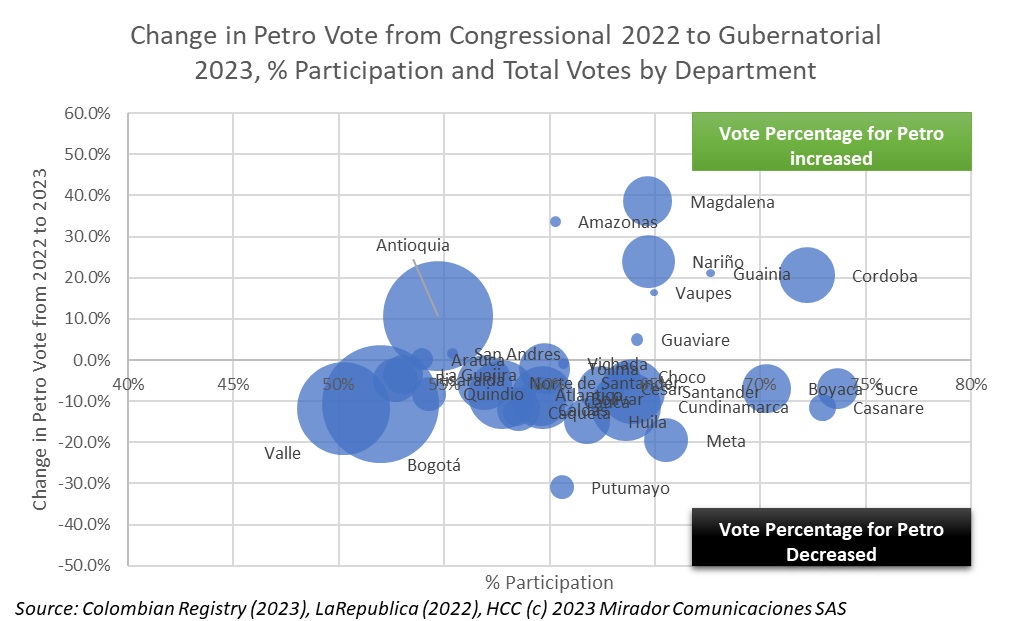
This question seems at the very least premature. While most Colombians (it appears but maybe not) are counting down the days (984 as of time of writing), oil and gas companies have long-term investments. Committing to them today means living with the consequences beyond August 6th, 2026. Who will be making the decisions on August 7th or, if “who” is too complicated, what kind of government will we have?
President Gustavo Petro’s announcement regarding a potential partnership between Ecopetrol (NYSE: EC) and Venezuela’s PDVSA has ignited a wave of skepticism and concerns about the feasibility of such a proposal.
Colombia’s economic scenario, as depicted by the DANE report for the third quarter of 2023, has not been as promising as anticipated.
President Gustavo Petro’s meeting with Venezuelan President Nicolás Maduro at Miraflores Palace sparked extensive discussions regarding Colombia’s economy and energy transition.
While much of Colombia was watching the national soccer team beat Brazil’s side for the first time ever in a World Cup elimination round, the Constitutional Court gave an important victory to the extractive industries by deciding that royalties are a deductible expense after all. The Petro government had tried to make them non-deductible in last December’s tax reform but the measure was almost immediately challenged in court.
The Ministry of Mines and Energy (MinEnergia) recently unveiled the strides made in the mining-energy sector in La Guajira as part of the citizens’ dialogues, led by Minister Andrés Camacho Morales, aiming to assess the portfolio’s achievements over the past year.
The Vice President of Operations, Royalties, and Participations of the National Hydrocarbons Agency (ANH) has announced Resolution 10981, adopting technical guidelines for evaluating the efficiency of torcheses for natural gas flaring in production.

2026, Hydrocarbons Colombia, All Rights Reserved.
