

Officials charged with managing Colombia’s sea commerce and resources met with oil companies performing offshore exploration to discuss regulations surrounding the activities.
The administrators of Colombia’s General Royalties System (SGR) hosted planning secretaries from the country’s departmental governments to discuss the accomplishments of the new royalty system in its first year and talk about its reach looking forward.
The director of the ANLA said that plans are on track to have reference terms for the environmental licensing of nonconventional exploration and production by November.

This article is not about Interoil despite the title of the graph. Instead, Interoil’s recent May production announcement brought us to this graph which we thought illustrated perfectly a more universal issue.
In 2013 almost none of the assigned royalties from mining and energy production have been executed for regional projects and last year the investment of these funds amounted to only 5% of the total COP9.1TR (US$4.77B).
The General Royalties System (SGR) is calling on Colombia’s academic institutions to help facilitate the proposal process in regions through a “Train the Trainers” program where the universities will play a greater role preparing regional institutions for the SGR proposal process. Parallel to this announcement, the entity also summarized the results of royalty investments in several areas and received new projects as well.
The implementation of the new General Royalty System (SGR) -now in place for a year- has yielded positive results including greater transparency and access to funds for regions, according to Mauricio Santa Maria, director of the National Planning Department (DNP).
Pacific Rubiales’ CEO Ronald Pantin rejected allegations from Colombia’s Comptroller that the company’s extraction practices in the Rubiales field are causing environmental damage.
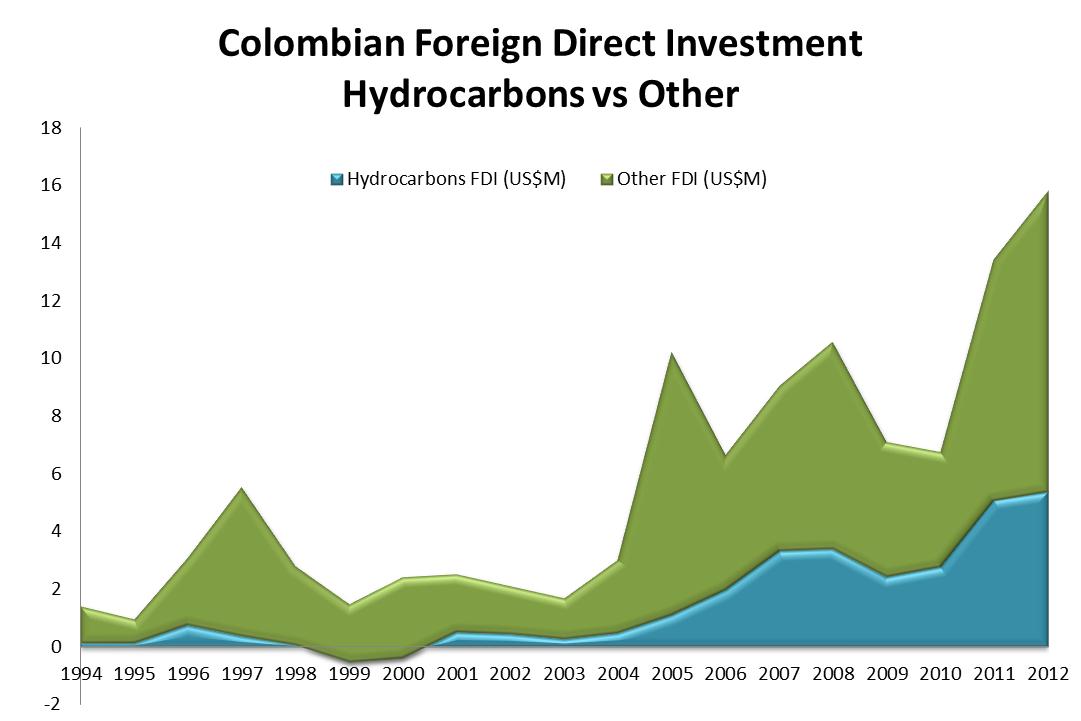
The oil sector accounted for nearly a third of all foreign direct investment (FDI) in Colombia in 2012, summing US$ 5.377bn of the US$ 15.823bn invested in the country during 2012, making it the 3rd largest destination of foreign funds in the region, according to an annual report on FDI published by the UN’s economic commission on Latin America (ECLAC).
Colombia’s mining vice minister Natalia Gutiérrez said that the government has decided to implement the Extractive Industries Transparency Initiative (EITI), joining Peru as the second nation in South America to do so.

2026, Hydrocarbons Colombia, All Rights Reserved.
