

Being December, this month normally has diminished expectations for progress on any issue. Traditionally, the political and judicial branches shut down around the 15th and nothing much happens until after “Reyes” the holiday corresponding to the Epiphany in Anglo-Saxon countries and which Colombia celebrates on the Monday closest to January 6th. On December 12th, the government and the ELN released a brief press release with limited, mostly procedural, agreements and shut down for the holidays. Then things really started to happen.
This is the last long essay before the holidays and usually I do a “Year in Review”. But we just did a “Petro 100 days” a few weeks ago and we wrapped up the Duque presidency from an oil and gas perspective in July. There frankly is not much new to say looking backwards, so I decided to look forwards somewhat. I attended the Parex Capital Markets Day last week and it got me thinking about why companies invest here.
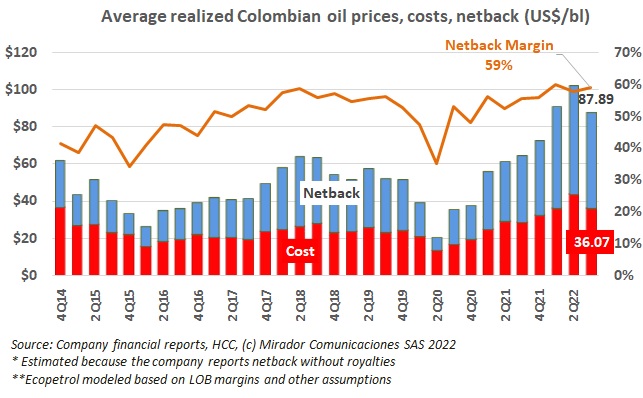
Oil prices fell in 3Q22 (you knew that) and so, as a consequence did netback. The good news is that margins have held largely constant this year, even up very slightly on average in the past quarter. As always we repeat the “EPA caveat” that individual company results may vary from this cross-industry comparison.
In a huge sunlight meeting room, in the Hotel Humboldt, high above Caracas, peace talks with the ELN kicked off on the 21st of November. The parties even announced initial, albeit mostly symbolic, agreements. Colombians celebrate small steps but the country has a long way to go.

The lead graph shows our annualized data for the evolution of Ecopetrol’s Net Income by Line of Business (LoB). The NOC has only reported through 3Q22 but we do a simple straight-line projection to compare to prior years. Barring some unforeseen implosion, shareholders can expect a record year for earnings driven by the E&P business. These results could not have come at a better time.
If, as expected, you read this in the Tuesday, November 15th 2022 newsletter, then Gustavo Petro celebrates his 100th day as President of Colombia. A Petro presidency was always going to be challenging but we do not think anyone anticipated the speed of the roller coaster we ride.
Like many things in this polarized world we now live in, most, perhaps all, Colombians fall into one of two camps: those who think Petro is a disaster and those who think there have been hiccups but he has brought about more change in three months than most presidents in three years. And like most things in this polarized world we now live in, both viewpoints contain elements of truth.
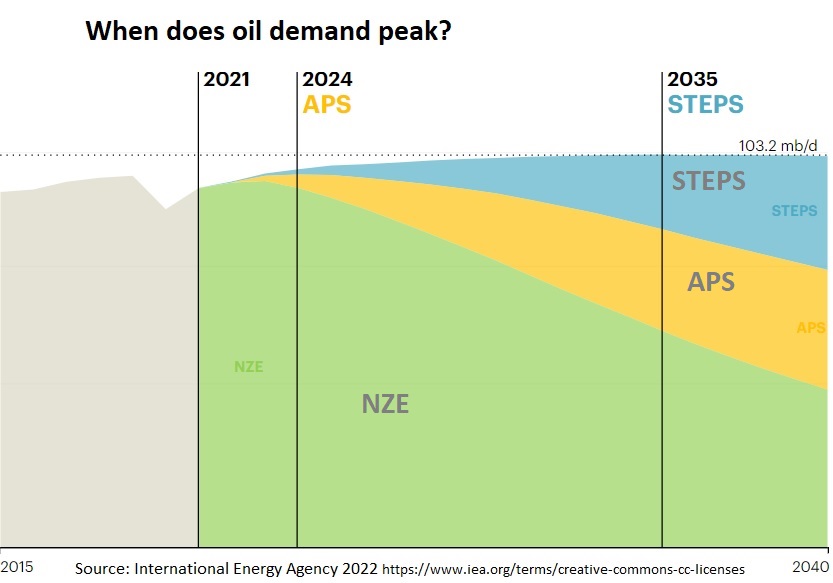
One of the key questions underlying the debate about the oil and gas industry in Colombia concerns when demand will peak and so for how long can public finances count on the flow of exports and tax revenues. Gustavo Petro’s “Illuminati” believe we all should stop using fossil fuels today and stop producing the stuff. More pragmatic observers think it too soon to (as some headlines put it) kill the goose that lays the golden eggs. Recently the International Energy Agency (IEA) weighed in with its view, based on various climate change scenarios.
The so-called FARC dissidents cause headaches for President Gustavo Petro’s “Total Peace” plan and this month’s debate over enabling legislation brought the issues to the fore, unfortunately without permanent resolution. The ELN process moved a small step and land reform took a giant leap.
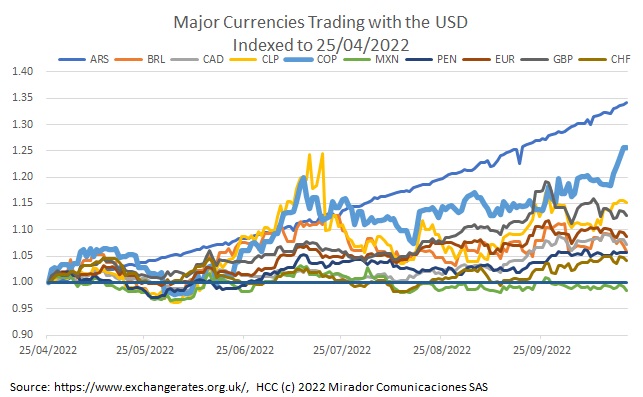
Our readers located outside of Colombia may not have noticed but the Colombia peso has soared lately, and pundits expect it to cross the 5,000 pesos-to-the-dollar barrier any day. It may have already done so by the time you read this article. Inevitably the finger pointing has started. Colombian President Gustavo Petro blames the United States. Business groups tend to blame Petro. In the interest of truth if not beauty, we looked at the data.
In late October of 2012, the ANH held a block auction as the centerpiece of a conference in Cartagena. Tomás de la Calle and I attended, distributing paper copies of the first Hydrocarbons Colombia monthly. The website had come up earlier in the week. Now, ten years after, the website continues to keep you informed, if not always entertained.

2026, Hydrocarbons Colombia, All Rights Reserved.
