

The freight, passenger, and dump truck transport sector, represented by the Association Chamber of Transport (Unidos) responded to statements made by Finance Minister (MinHacienda) Ricardo Bonilla, clarifying that they have been willing to engage in dialogue for a year and a half.
Colombia has taken significant strides in the decarbonization of freight transport, as highlighted in the latest report by GiroZero, a project initiated by the University of Los Andes.
In response to a staggering 300% surge in fuel demand over the past four years in the Amazon department of Colombia, Terpel undertakes a strategic expansion of its supply capabilities in Leticia, the region’s capital.
The diesel price in Colombia is set to undergo adjustments this year, according to announcements from President Gustavo Petro’s government and further confirmation from Ecopetrol’s (NYSE: EC) President, Ricardo Roa.
In the wake of the restructuring process initiated on September 8, 2023, by CB&I UK Limited, a subsidiary of McDermott International Ltd., in the UK, Refinería de Cartagena (Reficar), a subsidiary of Ecopetrol (NYSE: EC), received notification of a UK court’s decision approving CB&I’s financial restructuring plan.
Downstream companies continue their expansion and improvement plans for their service stations.
Colombia has once again underscored its global leadership in biodiesel production and consumption, reaching a historic milestone in 2023.
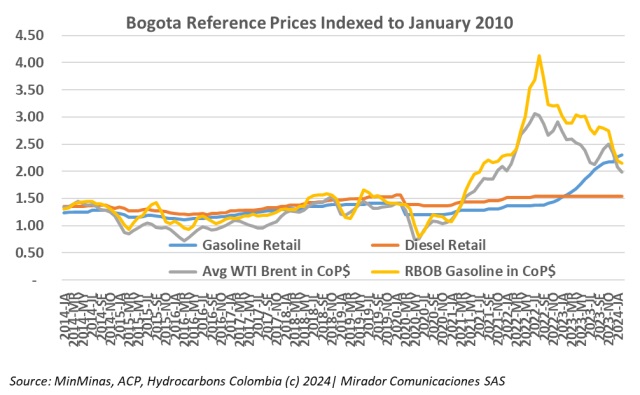
The Ministry of Mines and Energy (MinEnergia) announced a new increase in fuel prices in the last days of February. Here are the details.
According to the latest report by the Colombian Association of Petroleum and Gas (ACP), titled “Liquid Fuels in Colombia: Evolution 2023 and Perspectives 2024-2033,” the country will have an increase in its fuel tax collection.
The Colombian government’s decision not to increase diesel prices has resulted in significant fiscal costs to cover the subsidy.

2026, Hydrocarbons Colombia, All Rights Reserved.
