

Ecopetrol says that it has tapped Fernán Ignacio Bejarano Arias, who has worked with a number of public entities and boards, as its new legal vice president.
It will not be official until May 2016 but with Ecopetrol’s reserves announcement this week, it seems to us that Colombian oil reserves will drop over 10% to something under 2,100 mmbl.

Discussions between OPEC and Russia on reducing production have borne some fruit. The graph shows weekly closing prices for Brent and WTI during the past year.
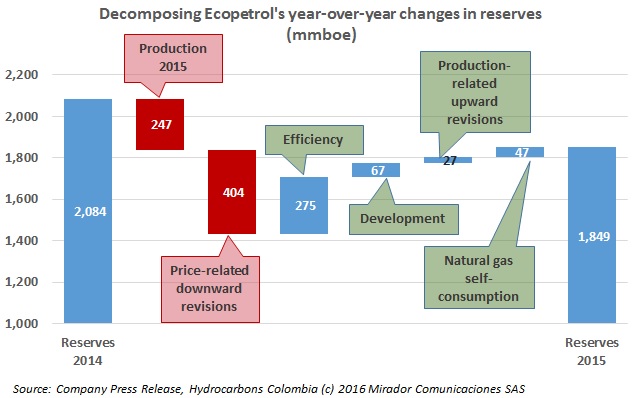
Ecopetrol (NYSE:EC) announced an 11% reduction in its 1P reserves of crude and natural gas in 2015, confirming a reserves/production ratio of 7.4 years.
Ecopetrol (NYSE:EC) has received permission from the National Hydrocarbons Agency (ANH) to suspend the Akacías field in the CPO-9 block in Meta, the second such shut in it has announced in as many weeks.
Julian Garcia Salcedo has been designated as the new president of TGI, the natural gas distributor owned by The Bogotá Energy Company (EEB) with one of the largest urban gas networks in the country.
Geopark (NYSE:GPK) updated its 2015 reserves count in Colombia, Chile, Brazil and Peru, reporting a net proven developed producing (PDP) reserve replacement ration of 150% for 2015. Its total net P1 reserve count increased 13% to reach 71.1mmboe.
A recent Gallup poll found that Colombians have a more pessimistic view of President Juan Manuel Santos and the peace process, a serious obstacle if the government hopes to approve an eventual agreement in a public referendum.

Fuel prices fell again in March, but the authorities still cannot shake the questions from consumers and press as to why they have not fallen further if oil prices are down substantially.
The Vice Minister of Mines María Isabel Ulloa attended the seveth annual meeting of the Transparency of Extractive Industries Initiative (EITI), and presented Colombia’s first report on the matter of transparency. She will also sit on the EITI board of the directors.

2026, Hydrocarbons Colombia, All Rights Reserved.

