

The Vice President of Operations, Royalties, and Participations of the National Hydrocarbons Agency (ANH) has announced Resolution 10981, adopting technical guidelines for evaluating the efficiency of torcheses for natural gas flaring in production.
In pursuit of the agency’s ongoing institutional strengthening strategy for conducting environmental studies in energy and hydrocarbons projects, the Nacional Environmental Licensing Agency (ANLA) has taken actions to enhance the quality of environmental impact assessments (EIAs).
Canacol Energy Ltd. (TSX: CNE) provided the following gas sales and drilling operations update.
Long-time HCC contributor and industry veteran Tomás de la Calle sent this analysis and commentary on the Petro government’s energy policy. We think you will find it useful.

Gran Tierra Energy Inc. (TSX: GTE) announced its financial and operating results for the third quarter of 2023.
Ricardo Roa, President of Ecopetrol, discussed the company’s focus on offshore natural gas resources.
In an upcoming Extraordinary Assembly of Ecopetrol (NYSE: EC), the Minister of Finance of Colombia (MinHacienda), Ricardo Bonilla, confirmed that there will be discussions about modifying the requirements for members of the company’s Board of Directors.
TGI, a subsidiary of Grupo Energía de Bogotá (GEB), reported a sudden drop in pressure in the La Belleza – Vasconia gas pipeline.
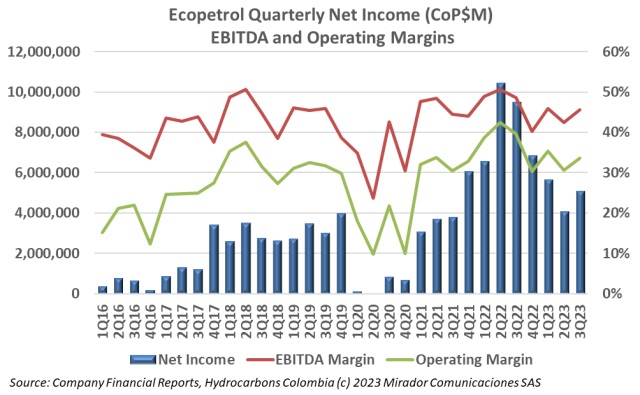
Ecopetrol (NYSE: EC) announced its third quarter 2023 results, with a continued decrease in key metrics.
Despite the Colombian government’s recent decision, led by President Gustavo Petro, to refrain from signing new contracts for oil and natural gas E&P, an announcement is expected to breathe new life into the natural gas sector.

2026, Hydrocarbons Colombia, All Rights Reserved.

