

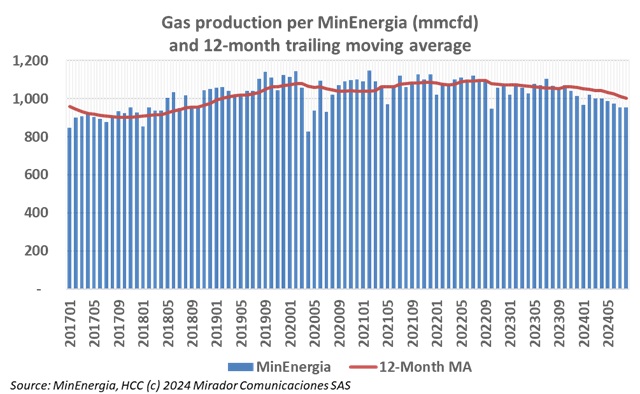
Luz Stella Murgas, President of the National Association of Natural Gas (Naturgas), issued a stark warning.
Following a recent meeting, Colombia’s governors, organized under the National Federation of Departments (FND), called on the national government to review the new formula for the General System of Royalties (SGR) budget for the 2025-2026 period.
The Inspector General’s Office (PGN) requested that the National Environmental Licensing Agency (ANLA) lift the suspension of the environmental licensing process for the Komodo-X1 offshore hydrocarbon exploration drilling project, located in the COL-1 block of the Caribbean Sea.
Seven years ago, Colombia celebrated what was hailed as the country’s largest natural gas discovery in four decades.
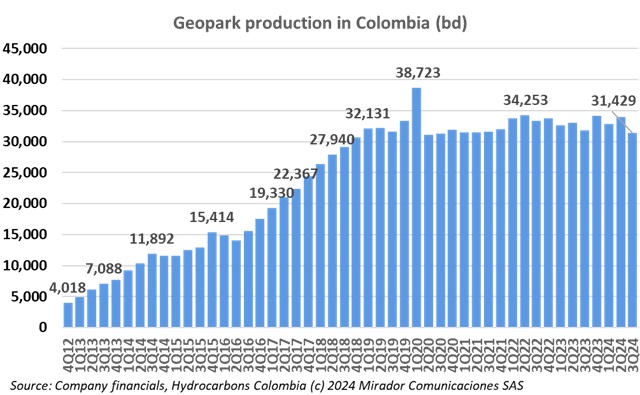
GeoPark Limited released its operational update for the third quarter of 2024 (3Q24).
In its ruling C-420, Colombia’s Constitutional Court upheld the corporate income surtax imposed on the mining and energy sector, as established in the 2022 tax reform.
Amid Colombia’s ongoing economic challenges and reduced gas availability, former commissioner of the Energy and Gas Regulatory Commission (CREG), Daisy Cerquera, presented strategies aimed at boosting the country’s gas supply.
Ecopetrol (NYSE: EC) is heading into 2024 under immense pressure.
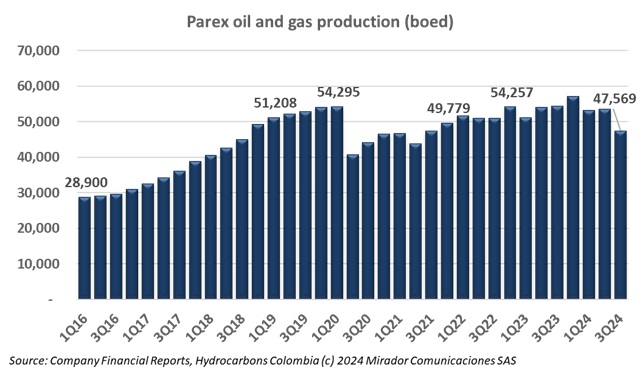
Parex Resources Inc. (TSX: PXT) released its production update for the third quarter of 2024. The company will announce its financial and operational results on November 5, 2024.
During the VII Oil, Gas, and Energy Summit, Rafael Guzmán, Executive Vice President of Operations at Ecopetrol (NYSE: EC), outlined the company’s strategic initiatives aimed at strengthening Colombia’s hydrocarbon sector.

2026, Hydrocarbons Colombia, All Rights Reserved.

