

This week the topic of post-conflict justice reverberated through Colombian media, as the issue of how to apply justice to former guerrillas once an agreement has been made. The government spoke of a transitional model for justice, which drew criticism from the political right.
The U’WA indigenous community has taken over an oil well in the Toledo municipality and accused the government of skipping out on a scheduled meeting. Reports indicate that the national government may enter with troops to gain access to the damaged Caño Limon- Coveñas Pipeline. UPDATED
This month we start with an interview with Independence’s Rose Marie Saab. She gives an optimistic view of the industry but a realistic one, based both on her role as the leader of Independence – a leading oil services company –but also as the chairperson of the board of Campetrol, the services industry association.
The ODL pipeline is planning a new pipeline extension that will run from Carmentea – Araguaney and together with the Yopal municipal council, Casanare Departmental Assembly and the municipal Advising Office of Planning will hold a series of community meetings to socialize the project.
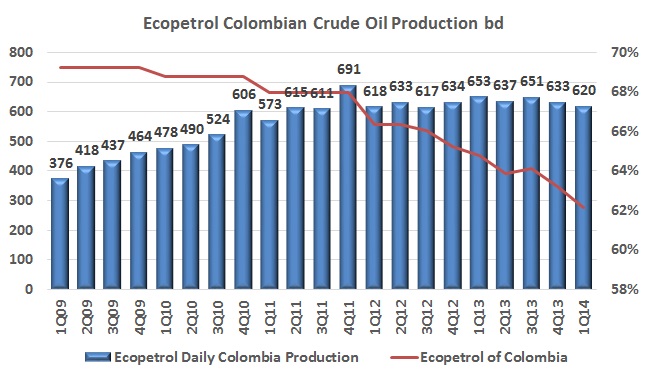
Ecopetrol (NYSE:EC) confirmed that the operational reality on the ground is cutting into its production abilities, which has coupled with increased costs and lower oil prices for a rough first quarter 2014 for the NOC.
A panel of authorities and experts led by the Vice-minister of Energy Orlando Cabrales participated in a seminar organized by the Colombian Petroleum Association (ACP) to highlight a number of policies designed to better communicate environmental practices and facts with the community in Casanare.
The Minister of Mines and Energy Amylkar Acosta published an opinion piece in which he highlighted the gains in terms of energy security for the country, pointing out that it is one of the highest ranked nations in terms of energy security in the region, something that will be crucial to prepare for potential effects of El Niño weather phenomenon.
GasPacific Rubiales (TSX:PRE) will receive US$75M from the International Finance Corporation, part of the World Bank, for a liquid natural gas LNG plant that it is building to export gas produced by the company from the La Creciente field.
During the debate on the Casanare drought in Colombia’s Senate, the Minister of Mines and Energy (MinMinas) Amylkar Acosta addressed accusations that oil production is depleting water resources in Casanare and addressed the increased seismic activity in Puerto Gaitán, Meta, saying that scientific research must confirm the causes.

The government has received substantial political pressure to lower fuel prices, but Ecopetrol (NYSE:EC) says it will continue to produce fuels despite a price that cuts into their margins and in turn, their ability to invest.

2026, Hydrocarbons Colombia, All Rights Reserved.

