


Thursday, August 20th, 2026
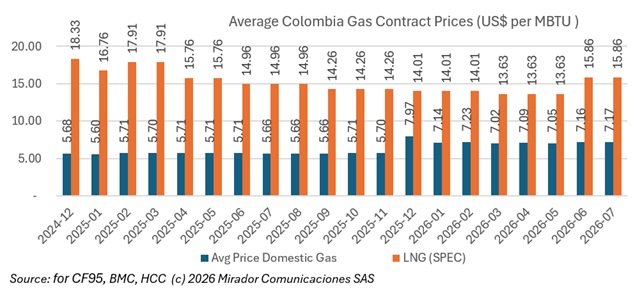
Aquiles Mercado opens his El Heraldo column with the etymology of a “leonine contract” – from Aesop’s fable of the lion who partners with others to hunt, then keeps the whole spoils – to argue that Colombia’s high LNG import prices aren’t unfair or predatory, but simply the market pricing a scarce good controlled by whoever sells it.
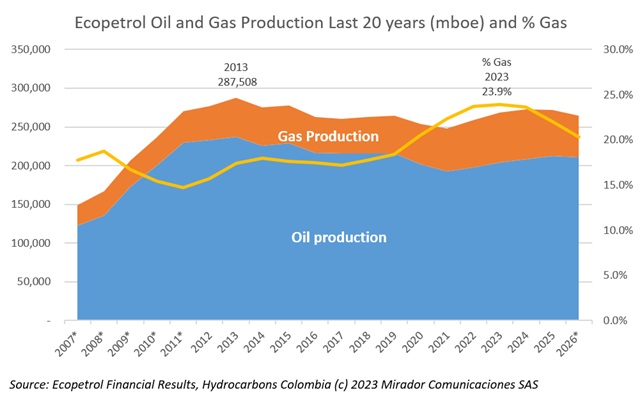
Ecopetrol’s gas sales volume fell 22.1% in the second quarter of 2026, with gas now representing just 6.9% of the group’s total sales — down sharply from 10.6% in 2Q22, when Gustavo Petro took office.
Argentina has become Latin America’s benchmark for unconventional hydrocarbons development, and Colombia is now looking to that experience as it moves toward authorizing fracking under President Abelardo De la Espriella.
Colombia’s exports grew 7% in June and 14.2% for H1 2026, but the gains are concentrated almost entirely in oil, coal, and gold, while agricultural exports fell.
The Asociación Colombiana del Petróleo y Gas (ACP) released an economic report, “Combustibles Líquidos: Pilar de la Seguridad Energética,” arguing that ensuring liquid fuel supply and reliability – diesel in particular – will be essential to backing up the electricity system during El Niño.
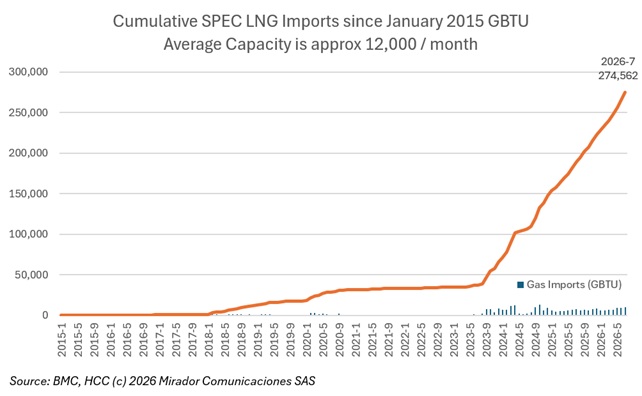
Calamarí LNG and SPEC LNG announced they’ve received their 200th liquefied natural gas cargo from Trinidad and Tobago, bringing cumulative imports to 12.8 million cubic meters – equivalent to 265 TBTU injected into the National Transport System – at a moment when El Niño’s impacts are threatening electricity supply reliability.
The national government approved a modification to SPEC LNG’s environmental license in Cartagena, adding 58 mmcfd of natural gas capacity to strengthen the country’s supply.



2026, Hydrocarbons Colombia, All Rights Reserved.
