

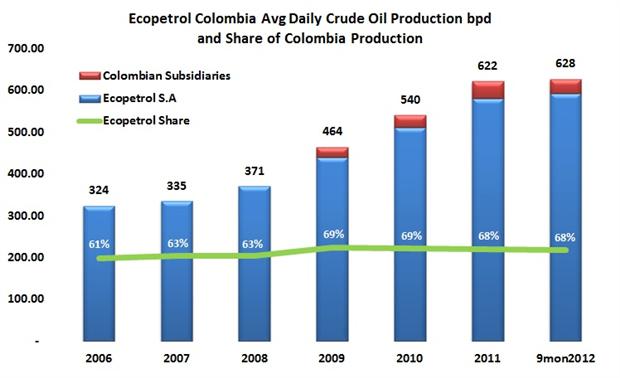
The company reported net profit between July and September reached CoP$3.24T (US$1.8B), which meant a decrease of 22.6% compared with the same period in 2011. Ecopetrol said that operating revenue increased one percent from the same period of 2011 while cost of sales increased 20.3%, due to maintenance costs of CoP$147,000M to ensure the integrity of transport infrastructure and wells, as well as the maintenance of Barrancabermeja refinery.
Azabache Energy, with oil and gas interests in Colombia and Argentina, published its year-end 2012, calendar 2Q12 results. The company reported a increased loss of CAD$6.6M including a charge for the impairment of certain assets in Argentina. It also provided an update on its exploration activities in Colombia and Argentina.
Early on in the Talisman 3Q12 results conference call, new Talisman CEO, Hal Kvisle, said that he would be visiting Bogota within a month. Given earlier statements he had made about exiting non-core assets and an announcement that the company would be leaving Peru, we wondered if his visit was for a goodbye party. We were very pleasantly surprised to hear the opposite.
This morning the legal firm of Norton Rose and the Canada-Colombia Chamber of Commerce (CCCC) held a seminar on anti-corruption practices with special emphasis on the American Foreign Corrupt Practices Act, the Canadian Corruption of Foreign Public Officials Act and the recent Colombian anti-corruption act. A large number of extraction industry firms are members of the CCCC and this issue is always a concern in these sectors. Indeed the only company ever prosecuted in Canada under the act was an oil and gas firm.
EnvironmentRCN Radio reports that Colombia’s Consejo de Estado (State Council) has ordered the regional environmental authorities (CAR) to supervise road repairs and by extension other major infrastructure projects for potential environmental consequences.
RCN Radio has been giving considerable coverage to the problems of Meta, not always with a positive view towards the hydrocarbons industry. Last week however, it wrote an article on the drive from Bogota to Villavicencio with an objective mindset. This route is used heavily by tanker trucks moving crude from the Llanos to ports and refineries and, on the return leg, naphtha as a diluent to the fields. The report makes it clear there will not be a solution to congestion and dangerous accidents anytime soon and that there could be short-term consequences for the industry.



2026, Hydrocarbons Colombia, All Rights Reserved.

