


Ecopetrol published its formal El Niño contingency plan on July 9, revealing the most consequential near-term contribution it can make to the national electricity system: two regasification projects that together will add 360 GBTUD of gas import capacity, equivalent to approximately 35% of national gas demand which could support up to 1,000 MW of additional thermoelectric generation through the critical dry season.
Three rural communities in Cartagena’s northern zone — Arroyo de Piedra, Arroyo Grande, and Arroyo de las Canoas — will receive piped natural gas service for the first time in their history, after Mayor Dumek Turbay Paz confirmed on July 6 that the Cartagena district government has secured the necessary resources through the Sistema General de Regalías.
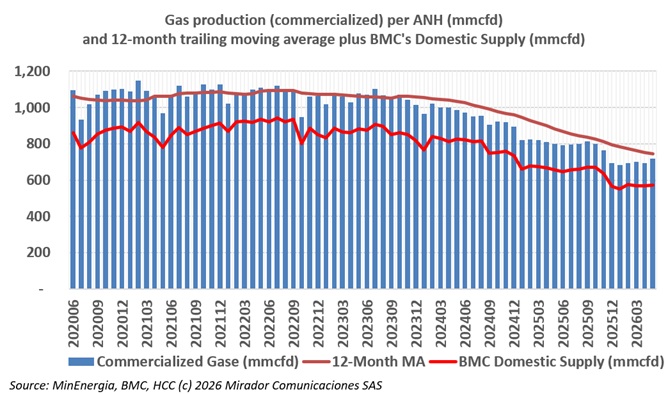
Colombia’s oil and gas production data for May 2026, compiled by Acipet from ANH figures and reported by Valora Analitik on July 9, confirms that the sector’s decline is accelerating – and that the gas side of the ledger is deteriorating far faster than oil.
President-elect Abelardo de la Espriella named María Nohemí Arboleda Arango as Minister of Mines and Energy on July 13, filling the one of the last major cabinet vacancies and the portfolio most consequential for Colombia’s energy supply crisis.
The Ministry of Mines and Energy used its July 9 four-year management balance to deliver a pointed political message to the incoming De la Espriella administration: suspending the energy sector transition handover process at the precise moment Colombia is preparing for an El Niño episode is, in the ministry’s words, “profoundly irresponsible.”
Venezuela’s interim government published sweeping new petroleum sector regulations on July 9, following up on changes to the petroleum law introduced in recent months.



2026, Hydrocarbons Colombia, All Rights Reserved.
