

GeoPark Limited announced a private investment in public equity (PIPE) transaction with Colden Investments S.A., an affiliate of Jaime Gilinski’s Grupo Gilinski, in which Colden invested approximately US$107M to acquire 12,876,053 newly issued common shares at US$8.31 per share.
The Ethics Council of Norway’s Government Global Pension Fund, administered by Norges Bank Investment Management, recommended excluding Ecopetrol from its portfolio over alleged human rights violations in its operating areas, effective March 2, 2026.
Martín Ravelo, who assumed the presidency of the Unión Sindical Obrera (USO) one month ago, outlined the union’s defense of Colombia’s oil and gas industry and its concerns about the government’s energy transition approach in an interview addressing fracking, Ecopetrol’s challenges, and political developments.
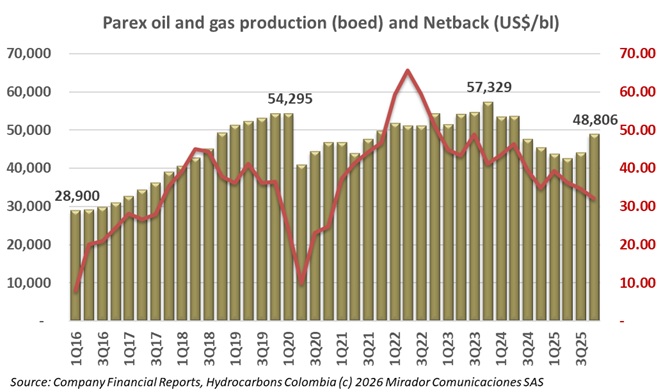
Parex Resources reported 2025 annual funds flow from operations of US$455M and free funds flow of US$145M, while increasing proved developed producing and proved reserves per share by 4% and proved plus probable reserves per share by 8% compared to 2024.
Arrow Exploration announced successful drilling and production results from two appraisal wells at the Mateguafa Attic field on the Tapir Block in Colombia’s Llanos Basin, where the company holds a 50% beneficial interest. Both wells were drilled on time and under budget, adding significant production to Arrow’s portfolio.
The Colombian Association of Geologists is developing legislation to integrate geological expertise into energy policy and territorial development planning, aiming to protect the environment while guaranteeing energy security.



2026, Hydrocarbons Colombia, All Rights Reserved.

