

Parex Resources Inc. announced today that it has submitted an acquisition proposal (the “Proposal”) to the Board of Directors (the “Frontera Board”) of Frontera Energy Corporation (TSX: FEC) to acquire all of Frontera’s Colombian upstream business in an all-cash offer for consideration of US$500 million, plus the assumption of debt, in addition to a contingent payment of US$25 million with terms that are substantially the same as the existing acquisition agreement previously announced. The Proposal represents a US$125 million premium compared to the existing acquisition agreement.
Canacol announces a leadership change and the appointment of an independent director to the board of directors (the “Board”). The Board believes that these changes will position the Company for success in the next phase of its restructuring by adding substantial restructuring experience to the Board.
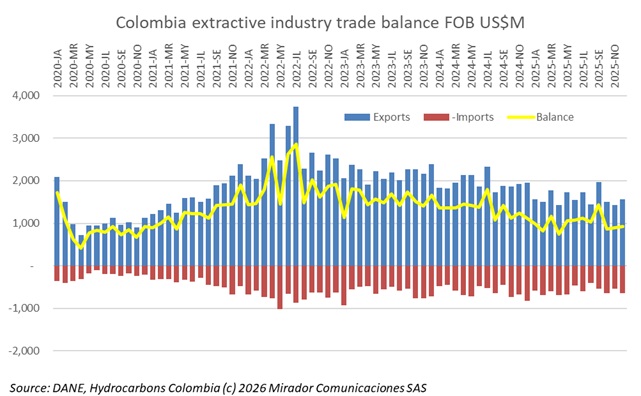
Colombia registered its worst trade deficit in history in 2025, reaching US$16.B FOB, surpassing pandemic-era records. Meanwhile, extractive industry trade balance contributed positively, although declining as well. DANE also published GDP for 4Q25 so we look at that from a sector perspective.
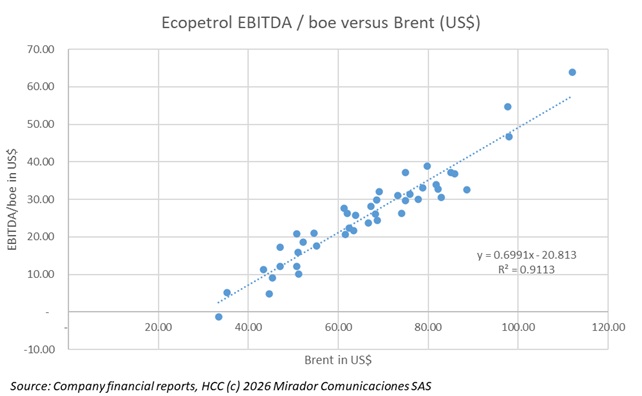
Colombia’s 2026 Medium-Term Fiscal Framework assumes Brent crude averaging US$62.3 per barrel, positioning Ecopetrol comfortably above its US$50 per barrel breakeven point quoted in third quarter 2025.
The Ministry of Mines and Energy announced February 11, 2026, that Pablo Yesid Fajardo Benítez assumed the presidency of Colombia’s National Hydrocarbons Agency (ANH), marking what the government described as “a new phase in the management of subsurface energy resources” amid energy security challenges and clean energy transition.
Promigas announced December 23, 2025, it brought online 20 mmcfd additional natural gas transport capacity ahead of schedule, increasing total capacity from 100 mmcfd to 120 mmcfd on the Barranquilla-Ballena Bidirectionality Project in a widely reported news item.



2026, Hydrocarbons Colombia, All Rights Reserved.

