


Ecopetrol (NYSE:EC) says that the fall in oil prices has forced it to suspend wells temporarily in the Caño Sur field, in Puerto Gaitán, Meta. A local operations manager said it has already filed the request with the National Hydrocarbons Agency (ANH).
Local authorities, unión leaders and sympathetic lawmakers have convened to call on the national government to declare a state of economic emergency in Barrancabermeja and to write a strategic Conpes document, looking at Ecopetrol (NYSE:EC) to compensate for canceling its plan to modernize the local refinery.
A lead Farc negotiator again rejected a plebiscite as the means to approve a final peace agreement, while congress has started to debate a bill which would cover many of the post-conflict special measures.
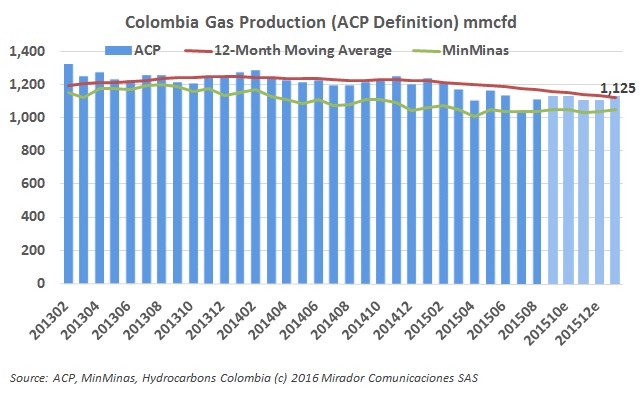
GasThe graph shows that, despite all the attention focused on natural gas, production continues to fall. Hard for prices to go down (as politicians would like them to) if supply is lower and demand is steady or growing.
After having cut CoP$2.8T from operating costs in 2015, Ecopetrol (NYSE:EC) announces further cuts for 2016 which are expected to save CoP$1.6T (US$0.5B).
The royalty budget planned for 2015-16 will not be manageable with oil at its current level, and needs to be cut by at least 30.8%, warns the General Controller. Meanwhile press reports on which regional entity is the worst in terms of royalty management abound. These and other stories in our periodic roundup.



2026, Hydrocarbons Colombia, All Rights Reserved.

